Letter from Langdon: Waste Not, Want Not

By Richard Oswald


Good Lifestyle Every meat processor wants to make use of as much as possible. But some things — lots of things — just don’t belong in a burger.

Back in the 1970s we were making our own ground beef when I got into trouble by cutting too close to the bone.

It was at the point in the butchering process that anything not in the burger went into the big dog waiting patiently outside the door. Our new electric grinder would handle just about anything I could mash in. Big Dog did not contribute to the bottom line, so my primary concern was saving every ounce of edible beef.

I should explain: In home processing, there’s always test grinding. A fresh beef patty is formed and fried to determine lean or fat, based on melted grease in the skillet. No grease and scorched meat meant we needed to add tallow to the mix. Shrunken burgers implied too much fat already.

It was noon time. As always we ate our tests for lunch. Then someone found a ground up grain of something in their first mouthful. All eyes turned to me, the grinder, as a chorus rose up:

“Don’t put gristle in the hamburger!!”

There are worse things than gristle. Several years ago I went to see Food, Inc., the movie. That’s how I learned why my pasty fast food burger smelled like ammonia. It was the ammonia wash used to reclaim contaminated packing-plant waste. Ammonia is good for nitrogen hungry plants, but anyone who’s ever changed a soggy diaper knows what it smells like. That’s the way the dollar burger I got in town smelled.

I ain’t no plant.

Way-back-when, my community decided to build our own packing plant. We said the new business would use every part of the cow but the moo. That meant the processing plant would be efficient and fast. Every bone, hoof, and hide…even blood… would be gleaned and sold just like we sold the beef. But not all together.

Quality was job one. Lucrative markets back East would give as good as they got. One thing we’d never do is sacrifice excellence, because excellence was what we were selling. So for us, eliminating waste meant utilizing all the parts — without mixing them.

There’s a whole bunch of stuff we take into our bodies today because someone stirs it into our food. Some kills bacteria, some adds flavor or color to make us think we’re eating something we’re not, some extends shelf life into the hereafter, and some contains filler just because it’s cheap and yields a tidy profit.


wiki Calcium chloride’s good for tractor tires, not so good for human digestion, so what’s it doing in bottled water?

Thanks to pink slime, consumers are beginning to question food-industry/government rubber-stamp joint partnerships that do more for corporate profits than quality assurance. They’re asking questions, like: Where does food really come from? Or, Why should ammonia-treated bacterial gristle be added to my hamburger?

And let’s not just interrogate meat. How about bottled water? One particular brand gives me heartburn. When I checked the label I found there was something in my drink besides plain old H2O. The label said I was also drinking calcium chloride for a “clean taste” and purity.

Calcium chloride is a heavy, corrosive salt that farmers add to water in tractor tires for weight and better traction. It also kills bacteria and keeps water from freezing. That’s why bottled water gave me indigestion.

It’s all about making cheap stuff into expensive stuff.

Take, for example, antibiotics. Big Livestock says it’s ok to use antibiotics continuously in livestock feed rations because germ killers make animals more feed-efficient. Actually, the germs that kill animals in raised in concentration must be controlled for the same reasons we treat adulterated hamburger or less than perfect water. Because eating the wrong stuff can kill us.


AP/Nonpareil online A butcher shop in Northwood, New Hampshire, responds to the pink slime revelations of March 2012.

They say mixing it all together makes food cheaper. That’s not exactly true. In fact it’s not true at all. What it really does is add things to our food that make more money for the sellers. If all the things we ate were mixed in deli-style, before our eyes, it’s doubtful anyone would ask for pink slime, tractor fluid, or anti-bacterials. We buy them not by choice, but because most of the time we don’t know even know enough to ask if they’re there.

Good food, water and air are three things everyone requires. Maybe some of us just think of food as fuel, the stuff our bodies process for energy, but there are other ramifications. Good food really is spiritual. The Bible talks about hunger and thirst all the time. One of the last things Jesus did on earth was have supper with his friends. And in Genesis 3:17-19 it says “By the sweat of your face you shall eat bread till you return to the ground, for out of it you were taken; for you are dust, and to dust you shall return.” Something to keep in mind.

One question Americans should never have to ask is whether the food we eat is safe or pure. But now it looks like we need to do just that. Too often, the tests that are intended prove our food is safe and good are actually carried out by those with the most to gain – corporations — while neutral government looks on. Lately, the governors of three states have even risen up in defense of pink slime. Is that public service or corporate service?

Real ground beef, I learned long ago, is clean. Significant amounts of e-coli bacteria aren’t normally found in muscle tissue. For e-coli to find its way into hamburger, someone has to put it there. Ammoniated impure stuff is mixed with our best and healthiest ground beef because the guys who profit from it say it’s OK.

I say it’s unholy.

Reprinted with permission.

Posted in General Advocacy, Pink Slime | Tagged , , , , , , , , | Leave a comment

A cabbage ain’t a rose

by Alan Guebert

It’s hard to mix today’s politics with today’s food and not get slime, slimed or both.

For example, when First Lady Michelle Obama harvested her first White House vegetable garden in 2009, political foes blasted her as a lettuce-crunching urban idealist.

That the garden saved money (First Families pay for their own White House meals), was a terrific value (its 740 lbs. of produce cost only $180 to grow) and showed that a mixture of sweat, dirt and desire can deliver sweet, even succulent, success didn’t matter.

To her detractors the garden was about politics, not potatoes; their perceptions, not its parsnips.

The governors of Texas, Iowa and Kansas played a similar game when they stopped briefly March 29 at a Beef Products, Inc. plant in Nebraska that makes lean, finely textured beef.

“Their half-hour tour… showed their support for the company and the thousands of jobs it creates in their states,” reported the Kansas City Star. No surprise; that’s politics and politics is what politicians do.

But the governors, Terry Branstad of Iowa, Sam Brownback of Kansas and Rick Perry of Texas, stepped through the political looking glass when they offered their full-throated defense of BPI.

For example, Branstad claimed BPI’s processed product is, “leaner than beef, which is better for you.”

Brownback went further out on the limb to note that “this is a 20-year-old product that has not had a safety issue surrounding it at all.”

Russell Cross, “a former administrator of the USDA Food Safety Inspection Service,” reported the Star, “agreed saying: This product has never been in question for safety.”

Not so. In fact, none of the above is true.

According to a lengthy Dec. 31, 2009, New York Times story, “(G)overnment and industry records… show that in testing for (USDA’s) school lunch program, E. coli and salmonella pathogens have been found dozens of times in Beef Products meat, challenging claims by the company and the USDA about the effectiveness of the treatment.”

That treatment, “injecting beef with ammonia,” explained the Times, was what the governors went to see and defend March 29.

In fact, the Times’ story continued, USDA’s “School lunch officials said that in some years Beef Products testing results were worse than many of the program’s two dozen other suppliers…

“From 2005 to 2009, Beef Products had a rate of 36 positive results for salmonella per 1,000 tests, compared to a rate of nine positive results per 1,000 tests for other suppliers, according to statistics from the program.”

(Links to the Times 2009 story, its 46 pages of supporting government and industry documents, and other sources are posted at www.farmandfoodfile.com.)

Beef Products did not deny those facts, reported the Times, but explained the disparity by noting “its testing regime was more likely to detect contamination.”

Wait a second. The problem wasn’t the higher rate of contamination; the problem was BPI’s ability to find it more often?

Oh, baloney.

Did BPI officials and their political defenders simply forget that it was BPI who confirmed these contamination problems to the New York Times in 2009?

Maybe.

And maybe it was BPI’s political grease—“(A)t least $546,500 to candidates for state office in Iowa, Nebraska, Kansas, South Dakota and Texas, where it has plants,” reported the Des Moines Register March 31—that caused the unsavory facts to slip right out of their collective memory.

Or maybe the truth, like facts, simply has no role in political discourse today.

And maybe it doesn’t matter that if consumers walk away from BPI’s product completely, an estimated 1.5 million more cattle will be needed to take its place.

For the record, 1.5 million cattle is far more demand created by consumers than all the demand created by $1.5 billion spent by the beef checkoff in the last 25 years.

On second thought, it matters. The truth always matters. Calling a cabbage a rose doesn’t make it a rose.

But you know that.

Reprinted with permission

© 2012 ag comm

The Farm and Food File is published weekly in more than 70 newspapers in North America. Contact Alan Guebert at http://www.farmandfoodfile.com.

Posted in General Advocacy, Pink Slime | Tagged , , , , , , , , , , , , , | Leave a comment

Beef is Beef – Really?

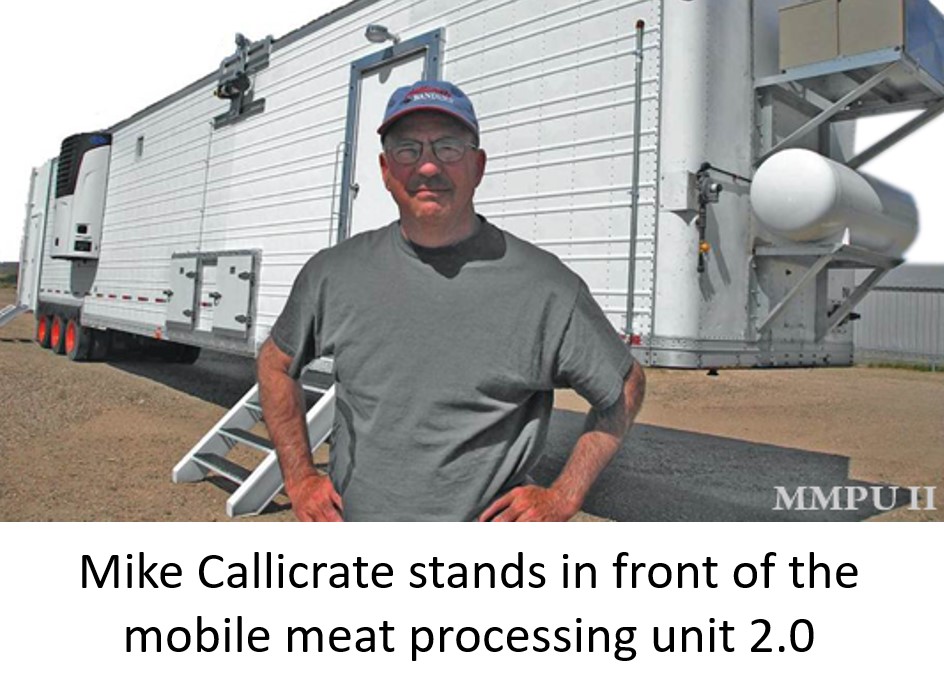
By Mike Callicrate

Iowa State University Animal Science students helped organize a “Beef is Beef” rally this week supporting Beef Products Inc. and touting the benefits of BPI’s Lean Finely Textured Beef (LFTB – Pink Slime). This was an impressive display of corporate toadyism. Industrial Ag cheerleaders and Pink Slime advocates, from Governor Branstad and his Lieutenant, to Congressman Steve King, recited lines from BPI’s PR script. Big Meat cheerleaders from the University, to the American Meat Institute, and Iowa Beef Council all parroted – “Beef is Beef!”


Jim Dickson, ISU Animal Science and Meat Science professor, speaking at the rally. He conducted studies for BPI on the ground beef additive, LFTB. He said the ammonia that was injected into the meat was a gas, but refused to acknowledge it was anhydrous ammonia. Professor Dickson, as well as other speakers, failed to mention the many pathogen problems experienced with LFTB.

And Bread is Bread

“Briefly summarized, the steel roller mill, monocrop agriculture, failure to conserve the soil or replenish it with humus, the combine, cyanogas treatment separation of grains and cereals into several fractions which are used and sold separately, the centralization of the milling industry, etc., have dangerously altered our food economy and culture with respect to breadstuffs.

“Sadly enough, instead of the consumer receiving nutritious bread products at a cheaper price, he buys a starch product of dubious and unproved nutritive value, which has to be enriched before it is considered fit to eat, and pays an exorbitant price for it.”

– The Church and Farming, 1953 – Dr. Phillip Norman, Lecture on the Fundamentals of Nutrition for Physicians and Dentists.

Like Rainbow and Wonder Bread, LFTB is a highly processed, chemically treated, nutritionally deficient derivative of beef, NOT the real thing. Why are our institutions, politicians and media providing false cover for BPI?

What happened to President Lincoln’s vision for the Land-Grant College system that he hoped would promote domestic agriculture and rural communities in teaching the skills of farming, livestock production and food processing? Have Land-Grants suffered the same fate as the USDA, which President Lincoln’s administration and Congress founded at the same time in 1862?

Last November, USDA Secretary Tom Vilsack, in acknowledging the 150 year anniversary of the USDA , said, “Through our work on food, agriculture, economic development, science, natural resource conservation and a host of issues, USDA still fulfills President Lincoln’s vision as “The People’s Department” – touching the lives of every American, every day.” Despite what Secretary Vilsack says, USDA is no longer the agency President Lincoln envisioned as the “People’s Department”. The Ames rally was a glaring example of how both the Land-Grant College system and the USDA’s “People’s” mission have been stolen by industry, for industry, in which the people serve rather than being served, and family farms producing good food for local communities become a thing of the past.

Animal Husbandry – Out of Sight and Out of Favor


April 10, 2012 – Animal Husbandry is only a faint memory on the backside of the old horse barn. In 1959, the college was officially renamed Iowa State University of Science and Technology.

Many years ago humans domesticated food, work and companion animals to serve their needs. Like good land stewardship, animal husbandry is a mutually beneficial relationship based on respect for the animal. Animal Husbandry without ethics, morals, animal welfare, and family farms is now called Animal Science.

Instead of providing our companion animals a healthy diet of real meat we feed them the same highly processed, fake food we eat. 50% of dogs are obese and are suffering the same degenerative diseases we are.

Pets for Real Food


Tonka, from Denver, Colorado, wonders, “Where’s the beef?” Sorry Tonka, it’s in the Pink Slime.

I graduated from Colorado State University (a Land-Grant institution) with a degree in Animal Science in 1975. The corporate-industrial model of agriculture was already deeply imbedded in the curriculum. We were advised that agriculture was not a way of life; it’s a business! Forget why your grandfather farmed. Family farm agriculture is a thing of the past. It’s now agribusiness. We have to feed the world, and it’s time to think and act like businessmen – economies of scale, efficiencies, thru-put, leverage, return on investment, get big or get out! I later realized I was being prepared to work for the industrial farming and food wealth-extraction machine – where the biggest cheater wins, and the big lie provides cover – a fool’s game.

The bright young Animal Science students at Iowa State University this week, like me 37 years ago, are ready to get out and go to work, except their chances of being in business for themselves will be far less. Conditioned to be willing serfs for industry, like our politicians, Secretaries of Agriculture and college professors, their future will most likely be in doing the work of multinational corporations, producing the food like substances described by Dr. Phillip Norman.

These students will fight their classmates for jobs with companies like BPI, Tyson, Cargill, Smithfield, JBS and Monsanto, where profit comes before people and community. In addition to becoming a slave for today’s corporate monopoly food machine, they will be expected to tout the same big lies as this week’s rally. They will have to be mercenary defenders of an industrial food system that searches the globe for the cheapest of everything; commodities grown and processed by the hungriest people that will work the cheapest, for sale in the highest consuming world markets.

Or, what is the chance these bright minds and able bodies can be part of something better? A food system that serves the people, protects the land, while showing respect for animals; a food system that builds communities, while producing abundant healthy local food. Perhaps they aren’t completely convinced; maybe they still have the curiosity and courage to look behind the corporate curtain, to work for better government policy. What if these students could be the job creators instead of the job seekers? What if they could believe in President Lincoln’s vision of 150 years ago, and return agriculture to healthy soils and a clean environment? What if these students had a new vision that provided real opportunities for family farmers and ranchers to live prosperous, happy lives in thriving rural communities while feeding all?

Posted in General Advocacy, Pink Slime | Tagged , , , , , , , , , , , , , , , , | 3 Comments

Pink Slime: Dark Side of Industrial Food System Exposed

by Mike Callicrate

“Changes will not simply happen…Changes will occur when consumers realize what they’ve been eating, get angry, and demand something different…It remains our responsibility, with every vote and every dollar spent on food, to start making it right.” (Eric Schlosser’s foreword from Slaughterhouse Blues.) Schlosser is also the author of Fast Food Nation and co-producer of the film that awakened America, Food, Inc.

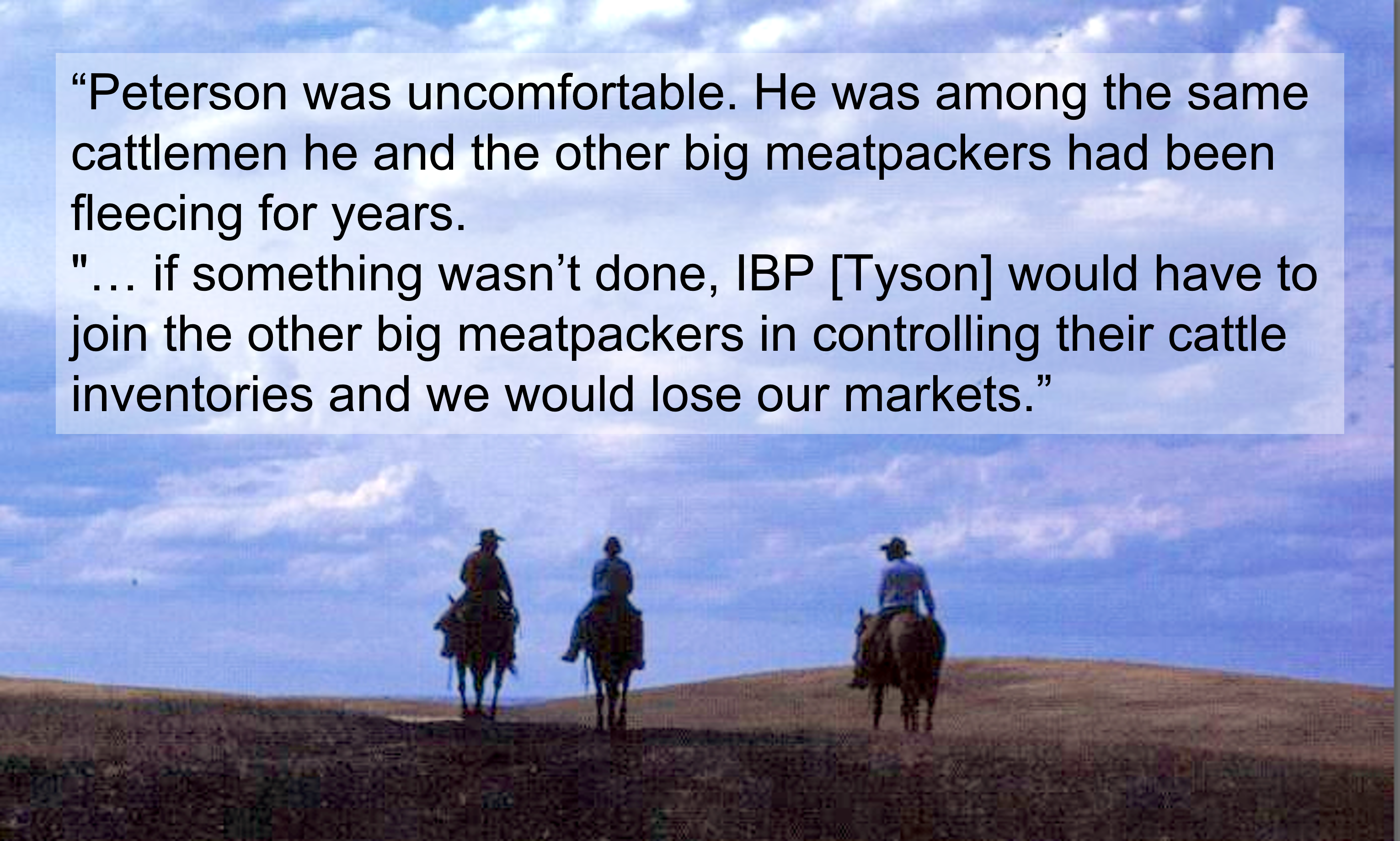
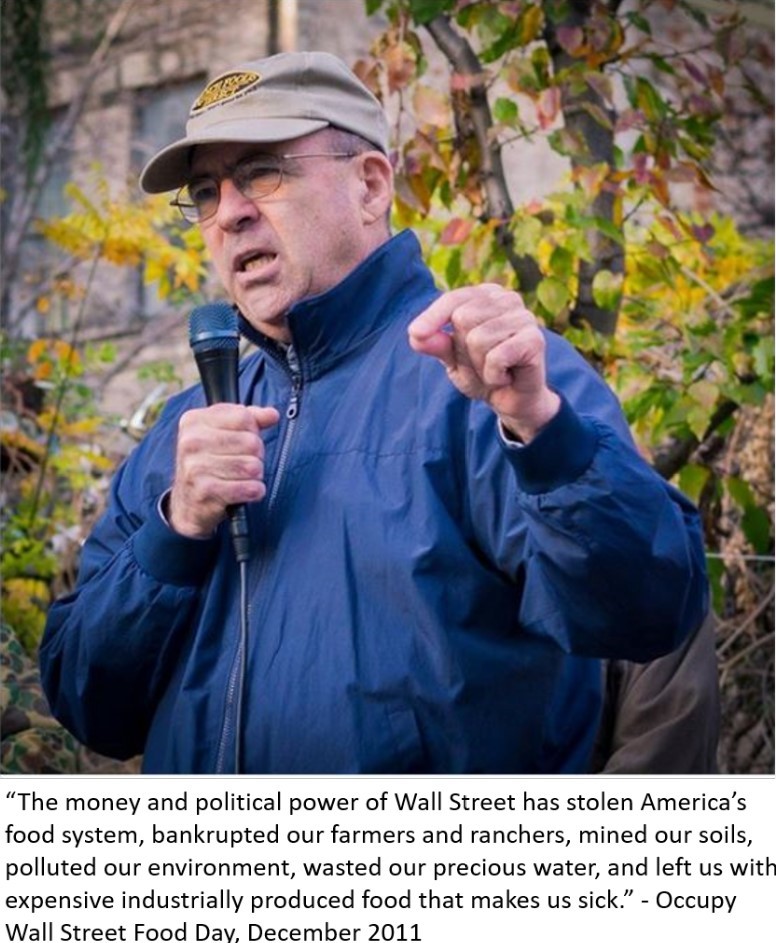
It was a beautiful spring day in 1996. American’s were convinced that eating fat was bad. South Dakota Governor Bill Janklow was holding a beef conference in Pierre, South Dakota’s capital city. Robert Peterson, President, and CEO of our nation’s largest beef packer, IBP (now Tyson), made a rare appearance to inform cattlemen of IBP’s importance to them and the State of South Dakota. Peterson was uncomfortable. He was among the same cattlemen he and the other big meatpackers had been fleecing for years. Just two springs earlier, in the face of barbeque season and rising demand, IBP along with Cargill and ConAgra had stunned cattlemen by reducing live cattle prices a devastating $17 per cwt. (over $200 per head) in just a few weeks.

Photo credit: Great Ranches of the West book

The last time I had heard Peterson speak was several years earlier at a Kansas gathering. He was warning cattle producers of the dangers to the marketplace if big packers owned cattle. He was talking about his big competitors, Cargill and ConAgra (now JBS), who were controlling large numbers of cattle at the time. He said these “captive supplies” of cattle disadvantaged IBP and if something wasn’t done, IBP would have to join the other big meatpackers in controlling their cattle inventories and we would lose our markets. He was right. Obama promised cattlemen a ban on meatpacker ownership in his 2008 campaign – he caved under pressure, giving big meatpackers permission to continue their unfair trade practices.

A Beef Products Inc. processing plant in South Sioux City, Neb. The company injects fatty beef trimmings with ammonia to remove E. coli and salmonella.

In Pierre, Peterson boasted about a new technology that could extract 11 percent lean meat from pure white fat. He explained how science and innovations, like this money-making technology, were an example of how big industry, executing with military-like efficiency and organization, could increase meat packers’ income, and in turn, he suggested, make the lives of cattle producers better. The technology he was referring to was one of the Advanced Meat Recovery (AMR) inventions of Eldon Roth, owner of BPI (Beef Products Inc.).

Peterson also reminded the large gathering of cattlemen about the ongoing challenges for companies like IBP, of the deadly bacteria E. coli 0157:H7. The Jack in the Box tragedy, still heavy on cattlemen’s minds, was a little more than three years old.

“During the panel discussion at the end of the day, Peterson called me a bald-faced liar and shouted profanities at my charges.”

Last to speak at the full-day conference, I reminded the group of the dangers of a highly concentrated, unregulated, and nearly monopolized meatpacking sector that had swindled struggling cattle producers out of their fair share of what consumers were charged for beef. Producers of good food we’re going broke, while eaters were getting sick. Big meat companies were posting extraordinary record profits. During the panel discussion at the end of the day, Peterson called me a bald-faced liar and shouted profanities at my charges.

July 7, 2002 – Gary Taubes article, “What If It’s All Been A Big Fat Lie?” in the New York Times Magazine, explained: “Starting in 1977, the government started telling all Americans to eat less fat and starting in the mid-’80s, we started producing these low-fat products that in effect replaced the fat in the yogurt or the cookies or the whatever with carbohydrates. We went from being a country that ate about 40 percent of their calories in fat and 45 percent carbohydrates, to 34 percent fat and that much more carbohydrates. Conceivably, this belief that set in, that carbohydrates could be eaten to excess and wouldn’t cause weight gain, that they were both heart-healthy and the ideal diet, might have had some effect on weight.”

Fat is where the nutrition is. We need good fat in our diets every day. It is an important source of nutrients and essential fatty acids that keep us healthy. Unfortunately, fat is also where bad things are stored, like antibiotics, steroids, hormones, arsenic, etc. – all compounds used by industrial producers to increase meat production.

“Laura’s Lean Beef is one of many independently owned companies that have failed to make it in a market where the biggest cheater wins and big lies provide cover.”

In response to this “fatphobia” and consumer concerns for saturated fat and cholesterol, Laura’s Lean Beef company was started in 1985. Misguided, fat-averse eaters were cutting back or completely avoiding beef in their diets. Today, Laura’s Lean Beef is one of many independently owned companies that have failed to make it in a market where the biggest cheater wins and big lies provide cover. Like a zombie, Laura’s consumer-friendly brand lives on, without her and her integrity, under the umbrella of a big processor.

So it makes sense that in the 1990s, inventor Eldon Roth’s answer to the low-fat craze was a technology for extracting lean tissue from fat along with other “Advanced Meat Recovery” (AMR) technologies, including methods for detaching meat and other tissue from the neck and spinal column bones. Meat byproducts that had been going into pet food were now going into people food. Huge profits were rolling in.

In this undated image released by Beef Products Inc., boneless lean beef trimmings are shown before packaging. – AP

In 1991 Roth began his production of Lean Finely Textured Beef (LFTB), now known as “Pink Slime“, which became a popular low-cost additive for big foodservice companies and chain eateries to include in ground beef. It was in response to what the industry perceived the consumer wanted – lean and low fat. The process included heating the meat trimmings to a temperature somewhere between the congelation (coagulation) temperature of beef fat, around 100 degrees, and the melting point of 113 degrees Fahrenheit – also, the perfect growing temperature for E. coli 0157:H7. This was Shangri-La for the bacteria – plenty of fat to eat at a perfect growing temperature.

“USDA, in their desire to protect the big packers, continues to block trace-back to the slaughter source.”

The Jack in the Box disaster followed in January of 1993. Like most big burger processors, the Jack in the Box supplier, Von’s Companies Inc., produced the contaminated ground beef from the lowest cost raw materials they could find – with no required trace-back to the source slaughter plant (foreign or domestic), where contamination occurs. Unbelievably, still today, USDA, in their desire to protect the big packers, continues to block trace-back to the slaughter source. Roth implemented his pH enhancement system of gassing the bacteria with anhydrous ammonia (which turns to ammonium hydroxide when mixed with water) in 1994 as an antimicrobial treatment to reduce the deadly pathogens in his product.

“We are dealing in global markets today. We need big companies that can do business globally.”

It is important to know that during this same time the big-four meatpackers were allowed to continue concentrating and consolidating the industry, putting smaller, local/regional, owner-managed companies out of business with their abusive market power and deceptive trade practices. In 1999, I asked Secretary of Agriculture, Dan Glickman, whose job it was to enforce the Packers and Stockyards Act, originally legislated in 1921, to protect producers from the monopoly power of big packers, why he didn’t enforce the law? He responded, “We are dealing in global markets today. We need big companies that can do business globally.”

At the same time, HACCP (Hazard Analysis Critical Control Point) inspection was being aggressively implemented, which removed many USDA inspectors from meat processing plants, giving the big meatpackers increased freedom to write their own food safety plans, essentially allowing them to inspect themselves, and to apply new experimental technologies like Advanced Meat Recovery processes. The ammoniating of meat was simply one attempt to treat one of many symptoms of a diseased, very sick deregulated industry.

Anhydrous ammonia (NH3) has a special meaning for any farmer having caught a whiff of it from applying fertilizer. It is a cheap form of plant nitrogen made from natural gas – an extremely dangerous and deadly compound. It basically kills whatever it touches – turning healthy living soil into dead dirt. Ammonia also has special meaning to anyone who has cleaned out a chicken house or used ammonia cleaner on windows or kitchen countertops. Who could have imagined it would be going into school lunches?

This was also a time of Wall Street worship and hyper industrialization, “get big or get out”.

This was also a time of Wall Street worship and hyper industrialization, “get big or get out”. Higher demands for thru-put and profit continued. Big meatpackers were touting the big lie of their economies of scale and efficiencies. Kill chain speeds increased to 350 to 400 head per hour (an animal dying every 9 seconds). The combination of lack of inspection, increased chain speeds, while pushing an unhappy and untrained refugee workforce beyond their limits, resulted in higher and higher pathogen loads on animal carcasses. It’s no wonder why sensible food safety technologies, like steam pasteurization and acid rinses, couldn’t keep up with the massive amounts of contaminated meat being produced on a daily basis.

The “fat is bad”, “food should be cheap”, “Wall Street is the economy”, “only an industrial food system can feed the world” mentality, reminds us of how science, poor judgment, and industry controlled government agencies can lead to some very bad outcomes. It is time to open the farm and ranch gates and packing house doors, fully revealing our food system to the public.

Unfortunately, “Pink Slime” is only a glimpse into a seriously dangerous and broken food system and is only part of the story of “What happened to the meat?”*

Leading animal welfare expert and author, Temple Grandin, offered to industry attendees at an animal welfare conference, “If you can’t explain to people at a Barnes and Noble in New York City what you are doing and have them understand and accept it, you shouldn’t be doing it.

Posted in General Advocacy, Pink Slime | Tagged , , , , , , , , , , , , , , , , , , , , | 5 Comments

Farm-to-School Inspiration Sets District 11 Apart


After watching the breakthrough documentary “Food Inc.,” which takes a look inside America’s corporate-controlled food industry, Rick Hughes, director of Food & Nutrition Services for Colorado Springs School District 11, set out on a mission to find out all he could about the foods that he was feeding the students in his district.

After doing research and speaking with nutritionists and his district chef Brian Axworthy, the school system set out to eradicate processed foods, hormones and preservatives from the breakfast and lunch menus.

“I’m not a food scientist, but I know how I feel when I eat highly processed food, and I wanted our children to be able to have food that makes them feel good vs. food that may not be the food that will help them in the classroom,” Hughes said. “So it was easy for our whole team to get behind.”

Colorado Springs D-11 made a commitment to its students and community when it began the Good Food Project that by 2012 there would be no high fructose corn syrup, processed foods with dye and preservatives or meats with added hormones on the district’s school menus.

Today, parents can even log onto the school’s website and see the ingredients of every element of breakfast and lunch, down to the homemade ranch dressing and chili con carne with cheese. Fresh fruits and vegetables appear on the menu daily and there is a vegetable of the month, along with a weekly review of the menu by Axworthy because he wants the students “to love what they are eating.”

Axworthy, who graduated from IUP Academy of Culinary Arts in Pennsylvania, says he is proud to be a part of such a worthy cause.

“Long ago I decided that I didn’t want to just join the restaurant world to make money and put money in my pockets; I wanted to do some more with my life and my talents so I started teaching and it was just another way to help with the community value,” he said.

D-11 over the years has partnered with Farmtoschool.org, Live Well Colorado and Ranch Foods Direct to provide the healthiest foods to the schools.

Galileo School of Math and Science, a D-11 school, even built the Galileo School greenhouse, which is a 42-foot diameter, growing space bio-dome, off-the-grid greenhouse that grows salad greens and herbs for D-11.

So now even the youngest of students will experience the flavors of homegrown lettuce and flavorful herbs.

Sunbelt Food service staff writer Ashley Bates recently spoke with Hughes and Axworthy about the exciting changes going on in school nutrition, their inspiration and the positive effect the menu changes have been on the students enrolled in D-11.

Q: First, tell me a little about the Good Food Project.
Hughes: What we believe in is based off of research that our team has done regarding our food system and the way our bodies process food and the impact on the brain. We made the commitment to our community that we wanted to eradicate processed foods in our schools by January 2012 based on what the market provides right now and to utilize local whenever possible and when financially feasible with the thin margins that we have. We have to make sure that we have a good value between the cost of food, paper and everything else that we are paying for in the school meal program. With the pennies that we have we can do that, and we want to give a good quality selection to 24,000 students each day across the city at 65 service locations. We’ve had, overall, a great response. If we have a loss one year it’s not a cause for great concern because we have so much – positive support from the community about the food we are serving their children.

Q: I read that your inspiration for the Good Food Project came from watching the documentary “Food Inc.” True?
Hughes: It wasn’t the Hollywood version of the documentary, (which was) pitching it as truth, but it was enough to create questions in my mind about what we were serving to our kids. So I started doing my own research, reading books and watching documentaries on the food system to formulate my own opinion. We have 300 employees, and we showed the “Food Inc.” movie right off the bat when we first started this to all of our kitchen managers and it was enough to get them going. Ever since then, we’ve just been giving them information as we find it about food and what it does to our bodies. And we want to support the local economy by buying local whenever possible. We use Ranch Foods Direct, a local cattle company. All their cattle is grass-fed, all-natural beef. We use them exclusively and it’s an amazing quality.

Q: Brian, why do you find it so important to serve the children nutritional food that they actually enjoy?
Axworthy: Our menu is tailored to what these kids actually want to eat. We looked at the menu and transformed it from processed products to all scratch cooking. Ultimately if we want the kids to eat it, it has to provide that nutrition, so it’s a balance right now on what they are willing to eat and how we can produce that in a nutritional format. Our goal is to provide better nutrition for the classroom, basically.

Q: Are you a professionally trained chef?
Axworthy: Yes. My resume is pretty diverse; I’ve worked at hotel resorts, I’ve been a chef at a hospital, a country club, convention centers. But I also became a culinary instructor for a local community college.

My background is pretty diverse and helps me in thinking outside of the box.

Q: Did you ever think that your career would take you to a school district?
Axworthy: That’s a great question. Not really, but when I met Rick and the team and we talked about doing this project and researching it, we knew that it’s a very noble cause and definitely worth being a part of.

Q: Do you get federal money to fund your food program? Or is it state money? How does that break down?
Hughes: We receive federal money for every meal that meets the Dietary Guidelines for Americans; the parameters we have for school meals are set by the USDA (United States Department of Agriculture). That money is different depending on whether the students qualify for free meals. We get that through reimbursement or reduced meals. There is a little bit of reimbursement for each one of those different categories.

Q: I know a lot of people always think that healthier is more expensive. Is that what you are finding?
Hughes: It does cost more to shop at Whole Foods than Walmart, but there are ways to make it happen, there are ways to do it without costing more. You basically shift your budget categories and you spend a little more on food and a little bit less on labor costs, or vice versa. You could buy a cheap processed burrito and pay the price for that or you could make a burrito from scratch with locally grown pinto beans, maybe local cheese and local tortillas from a local company and, even if it isn’t local, there is a way to put those things together with a better quality. That way, you know exactly what is in that burrito and you’re not relying on the chemical binders that are in the processed food.

Q: Brian, do you create the menu yourself for all the schools or how does that work?
Axworthy: Actually, what I do is get feedback from the students as well as our staff on a weekly basis and find out what things they like and what things they don’t. Then I gather all that and every semester I decide what we like, what we should revise. That has been very successful because we go through those steps and we have a wealth of knowledge on our team. They have helped me go into the right direction.

Basically, when I see a menu item, I ask, “how do we make that?” “how long is this part going to take?” “what does the transportation look like?” “what does the end product look like?” etc. This is how I determine what steps we need to take to get from point A to point B. In just a few semesters we are getting where we want to be. We have pancakes with fruit syrup on the menu because the kids want it. Originally they wanted maple syrup but that has high fructose corn syrup in it and our Good Food Project prohibits the use of that product. So we decided to make a fruit syrup.

Q: I’m sure you are excited spring is coming because of the selection of fresh vegetables and fruits. What kinds of things do you have planned for April or May?
Hughes: The California strawberry season just kicked up into high gear so we’ve featured strawberries this week. And we’ll be serving them next week as well as some clementines.

Q: I read that you have an employee boot camp. Can you tell me a little about that and explain how that works?
Hughes: We are partnered with LiveWell Colorado and its initial training program. (Editor’s Note: LiveWell Colorado’s Freshen-Up School Food Initiative encompasses several programs that work with schools directly to train cafeteria workers to prepare fresh, made-from-scratch meals, and motivate and educate students about making healthy food choices; see box.) We have been through that process for three summers and will continue to do that to increase the skill set of our staff.

Q: How much does breakfast and lunch cost at your schools?
Hughes: Breakfast prices range from $1.15 to $1.25 in our school district, depending on the grade level, and lunch ranges from $2.05 and $2.45.

Q: What would you say to other school districts across the country about why they should – become a part of the Farm to School movement?
Hughes: We think it is the best thing for kids. There is a lot of research out there that is pointing to what is in our food. The health of America is in a precarious place right now with the obesity rate and the issues that are resulting from obesity, and we are all paying for it in the healthcare system. Certainly exercise is a huge piece of that, but I don’t have control of physical education in our school district. But I do control serving 24,000 meals each day. So we can have an impact on the food system and there is research that shows that is true. We are buying into that, saying that we don’t want foods that are highly processed, processed by chemicals, preservatives and artificial food coloring, things to make the food look pretty and perfect. Those things aren’t providing healthy, sustainable food for our kids. It all comes down to health.

Q: You mentioned one specific farmer you use. I read about a school district in Florida that actually had the farmers come to the schools for a bidding process. How does D-11 conduct this search?
Hughes: We are doing farm to school with our local state association of Farm to School. We’ve had some great partners, and I think a huge key to success is having good partners not only in the community but also in the producers, the growers and farmers. We have been working with some farmers to develop food safety standards for the farms that we buy from. That collaboration we have with farmers has helped us leaps and bounds to develop systems of procurement and systems of food safety that we can all be comfortable with.

Q: Rick, how long have you worked with the school district?
Hughes: I’ve worked with the school district 11 years, since 1997. I came to D-11 as a foodservice manager. I used to work for Sodexo Marriott. Sodexo and the school district decided that they could do bigger and better without spending half a million dollars annually on a management company. While I’ve worked with D-11 since 1997, it’s only been the last five or six years that I have worked for the school district (in a capacity) where I could make these changes.

Q: Can you tell me your connection with the Galileo School?
Hughes: The Galileo garden project is one of our projects where we are growing our own food basically. Right now there isn’t a lot of sunlight because the sun is so low in the sky, but we are putting an emphasis on fresh herbs. We are able to utilize those in our meal program.

During the early fall, when it is still good growing season, we were growing quite a bit of lettuce and getting high yield.

Q: Do you think it is a good thing to get children used to those flavors at a young age?
Hughes: We think that is a huge key. Our food has so much flavor now, it’s wonderful. It is going to take that flavor profile to get kids used to it and move them from a diet that’s mostly salt, sugar and fat in the processed foods to real foods that are good for them and really taste good. It’s awesome.

Q: What changes have you actually seen in the kids as far as grades, classroom behavior, etc.?
Hughes: It’s a little bit anecdotal, but we have had a lot of feedback from teachers and they say that behavior in the classroom is tremendously better and they are able to concentrate more. We have so many initiatives going on in our school system right now it’s hard to look at grades or test scores and know what did it. The feedback that we are getting from parents, principals and teachers is overwhelmingly positive. If we lose 6 percent on the revenue side, we’re OK because ultimately we want to serve kids good food, we want to serve kids food that is going to help them, and if I’m able to break even in our food service program, which is the ultimate goal, we’ve achieved all of our goals.

Source: The Shelby Report


In the Media: D-11 serves Callicrate Beef distributed by Ranch Foods Direct

Schools Can Choose ‘Pink Slime’ Or Not
The USDA is going to offer schools the option of serving beef patties with “pink slime” or without.
by AP, KKTV 11

Is “pink slime” being served to your child?
by Sade Mally, FOX21


Need “Real Meat” in Your School?
Please contact Ranch Foods Direct at (719) 473-2306 or email us today!

Posted in General Advocacy, Pink Slime | Tagged , , , , , , , , | Leave a comment