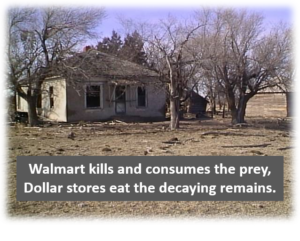
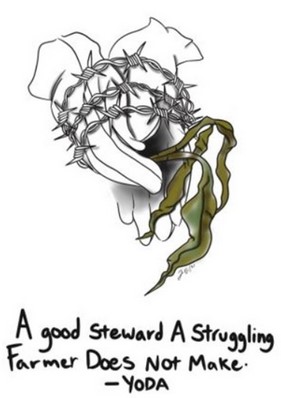
This is a collection of Wally Cartoons you have seen on previous Cattlemen’s Legal Fund issues. All of these cartoons are so good, we decided to offer them here.
Click on the Pics to Enlarge.
 |
 |
 |
 |
 |
 |
 |
 |
 |
 |
 |
 |
 |
 |
|
 |
 |
 |
This is a collection of Wally Cartoons you have seen on previous Cattlemen’s Legal Fund issues. All of these cartoons are so good, we decided to offer them here.
Click on the Pics to Enlarge.
|
|
|
|
|
|
|
|
|
|
|
|
|
|
|
|
|
|
| OCM Optimistic Pickett Jury Verdict will be ReinstatedLincoln ~ The Organization for Competitive Markets (OCM) expressed optimism the 11th Circuit Court of Appeals will uphold the $1.3 billion jury verdict in the Pickett v. Tyson Fresh Meats, Inc. cattle price manipulation case. A three judge panel heard oral argument on Friday, December 17, 2004 in Montgomery, Alabama.
Joe Whatley, co-lead trial counsel, argued the case for the Plaintiff Cattlemen. He told the court the jury’s decision that Tyson manipulated cattle markets for eight years without justification should be upheld. “The issue is not what the court would have decided, but whether the jury could reasonably have found,” Whatley said. Whatley is an experienced class action attorney and 11th Circuit appellate lawyer. The jury found, on February 17, 2004, Tyson manipulated the cattle market from 1994 to 2002 causing nearly $1.3 billion in damages to cattlemen. Judge Lyle E. Strom overturned the verdict on April 23, 2004. Strom believed Tyson’s actions were justified by a desire to achieve a reliable and consistent supply of cattle and to “meet the competition” because the other packers used captive supply as well. Plaintiffs appealed asking the 11th Circuit to reinstate the verdict. Judges Emmett R. Cox, Ed Carnes, and Richard Mills questioned both sides extensively. “This is a unique and complex case,” said Judge Mills. Judge Carnes forced Tyson’s counsel, Carter Phillips, to admit that if captive supplies are unlawful, then it is no defense to say others are engaging in unlawful behavior too. “I have this vision of all the packers standing in a circle pointing at each other,” said Carnes. Carnes also questioned Tyson’s claim that the company could not control when captive cattle were delivered while also claiming they achieved a consistent and reliable supply of cattle with the practice. “Can you explain this contradiction?” Carnes asked Tyson attorney Carter Phillips. Cattlemen attorney Whatley pointed out Tyson’s expert, Michael Hausman of the Massachusetts Institute of Technology, tried to convince the jury that captive supply does not cause lower prices. “Hausman thought cattle were on feed only two weeks,” said Whatley. “He did not know anything about the industry.” Under intense questioning, Tyson attorney Phillips admitted the jury was free to believe Plaintiff’s expert Bob Taylor and disbelieve Tyson’s experts. “This is probably the most important case in the cattle industry,” said Fred Stokes, OCM Past President who attended the hearing. “We are optimistic the 11th Circuit will recognize Tyson broke the law and help restore fairness, access and competition to the cattle markets.” The Organization for Competitive Markets (OCM) is a multidisciplinary, nonprofit group of farmers, ranchers, academics, attorneys and policy makers dedicated to reclaiming the agricultural marketplace for independent farmers, ranchers and rural communities. OCM helps lead the Cattlemen’s Competitive Market Project which is a voluntary contribution program funding the effort to increase demand for U.S. cattle and beef in open and competitive markets. |
|||
| Cattlemen Want Courts To Honor A Jury Verdict In Their Favor |
| Nebraska News – http://nebraska.statepaper.com/vnews/display.v/ART/2004/12/22/41c99d0ed53f0 |
| By GEORGE LAUBY / North Platte Bulletin December 22, 2004 |
| The validity of a jury verdict is at stake in an agricultural anti-trust case brought by cattle sellers against the world’s largest cattle buyer.A jury previously issued a verdict for the cattlemen, but the trial judge disagreed with the panel and substituted his view for that of the jury. The current appeal followed. In part, the cattle sellers argued that the trial judge acted improperly. They cited the Seventh Amendment to the U.S. Constitution: “In Suits at common law, where the value in controversy shall exceed twenty dollars, the right of trial by jury shall be preserved, and no fact tried by a jury, shall be otherwise re-examined in any Court of the United States, than according to the rules of the common law.” After eight years, the debate between Alabama cattleman Lee Pickett and others against Tyson Fresh Meats moved to the 11th Circuit Court of Appeals. A panel of three judges recently heard oral arguments in Montgomery, Alabama. The court is one step short of the U.S. Supreme Court. Two of the cattlemen challenging Tyson are from Nebraska — Chris Abbott and Bob Rothwell of Hyannis. At issue is the way Tyson buys cattle – namely the legality of private, unwritten agreements with some cattle sellers. Tyson is using more unwritten agreements all the time, Phillips said. Judges sharply questioned attorneys from both sides for an hour and a half. Among other issues, they pressed cattlemen’s attorney Joe Whatley about how to accurately identify the cattle sellers that had allegedly been harmed. Whatley argued that a jury verdict is protected by the 7th amendment of the U.S. Constitution and urged the judges to uphold it. The Pickett case began eight years ago, pressed by cattlemen who allege unwritten marketing agreements allow Tyson to bid less for cash cattle, driving down the overall price. The cattlemen say when Tyson buys cattle under unwritten arrangements, the company knows well in advance about how many cattle will arrive at the packinghouse. Therefore, the company bids less aggressively for the rest of the cattle they need. The cattlemen want a virtual 100-percent return to the bidding system, so there is meaningful “price discovery.” After a month-long jury trial early in 2004, a 12-person jury agreed with cattlemen. However, two months later the judge in the case overturned the verdict. The judge said it is too difficult to find the cash sellers who were specifically harmed, and that Tyson had a legitimate business motive for offering the private deals – to keep up with its competition from other cattle buying companies. The judges fired questions at attorneys Whatley and Phillips during the hearing earlier this month, asking: “Did you prove that the overall price of fed cattle was lower than it would have been without these agreements?” Judge Edward Carnes asked Whatley. “By definition, we did,” Whatley said, referring to a cause and effect relationship. Lower overall prices are a logical result of secret arrangements with a few cattle sellers, especially if they buy in large quantity, he said. Judge Richard Mills suggested the jury’s award could have been determined by “a roll of the dice.” In defense of the estimate, Whatley said Auburn economist Robert Taylor testified at the trail that the damages could have been about $2.1 billion over eight years, but the jury had authority to set that amount higher or lower. Going on the offensive, Whatley said the jury’s findings are protected under the U.S. Constitution. “The question is — is it proper to set the jury’s verdict aside?” he said. “That is what you have to decide. The question is not what you would have decided.” The 1921 Packers and Stockyards Act prohibits “any unfair practice” in livestock buying, and any act that has “the effect of manipulating or controlling prices.” Tyson attorney Carter Phillips, on the other hand, maintained cattle producers ask for the unwritten marketing arrangements, and Tyson must grant them to keep a reliable supply of cattle coming to the packinghouse. So, all cattle must go to the packinghouse eventually, regardless of how they are bought, Carnes noted. Judge Emmett Cox said cash prices might not be used at all by 2008 or 2012 if the trend continues. He compared cattle marketing agreements to hog buying contracts. What base price will be used if the cash market disappears, Cox asked? “I suspect it would come down to whatever the packer wants to pay,” Whatley said. Under questioning, Phillips attacked Taylor’s estimate of damages and said his testimony should not have been allowed. He said the district court judge seemed reluctant to allow Taylor to testify. Phillips suggested cattlemen, if they feel victimized, should appeal to the Secretary of the U.S. Department of Agriculture, the cabinet officer that oversees enforcement of the Packers and Stockyards Act. Or, cattlemen should ask Congress to update the act. But Whatley stressed that jury verdicts are protected under the 7th amendment. He asked the court to reinstate the verdict. Another goal in the case, Whatley told the court, is to put the cattle market back on a cash bid basis so it will “work the way it is intended to work” and provide an open market that is accessible to all cattle producers. |
Abstract
Defining competition in a U.S. Courtroom involves the analytical and intellectual collision of the law’s pragmatic aspects with the academic realities of economics. Both disciplines depend heavily upon competition, and employ a rich dosage of competition language.
However, “competition” in law and “competition” in economics are dramatically different.
Economists often study market efficiencies. In an academic setting, economics and econometrics evaluate efficiency, and assess its achievement or failure. As a social science, the study of markets by economists often involves the specific assessment of market efficiencies.
Here, too, the law’s social disciplines differ greatly from those of academic economics. Except for a few aberrant moments of brief duration, the process of making, enforcing, and litigating over legal principles in history’s democracies has never involved pursuit of an efficient economy, or even an efficient legal system. To the contrary, the law’s goal is to govern behavior to ensure fairness, justice, legal compliance, and not efficiency. Through analysis of a history-making U.S. cattle market trial, this paper considers legal “proof” and illustrates application of the rules of evidence and courtroom-level definitions of “proof” and “evidence.” Routinely, juries are instructed on what constitutes proof, and what does not. In the legal case that provides this paper’s illustrative focus, the United States District Court’s definition of evidence for the jurors, the court’s rulings on evidence issues, and the lawyers’ arguments of the evidence to the jury impacted an entire industry.
The case provides a useful tool for studying and defining competition in a U.S. courtroom.
KEYWORDS: Full Article (PDF) 11-04DominaTyson
The CommStock Report – 04/26/04
Copyright 2004 (C) CommStock Investments, Inc.
David Kruse
Retransmission, copying, or forwarding without permission is Illegal
Picket versus IBP isn’t over
When U.S. District Judge Lyle Strom overthrew a jury verdict against IBP in the Pickett versus Tyson cattleman’s class action lawsuit, I wasn’t shocked or surprised. I didn’t think the system worked and the Judge only confirmed my suspicion. My initial response was that if a judge can overrule a jury, why bother with the jury process? Why should plaintiffs even bother to argue a case to a jury when a judge has veto power over the procedure? It seems like a whole lot of trouble and expense to go through to pick a jury, disturb their lives, have Tyson lawyers and economists insult them as not being smart enough to decide a case this complicated, and then have the judge pitch their finding. If I was one of the jurors, I think I’d find Judge Strom in contempt
of court. It’s hard not to have contempt for such a system.
We’re told in grade school that the U.S. legal system is based on a right to a jury of our peers. I wasn’t informed of any fine print that said if a judge didn’t like a jury’s verdict that he could throw it out. Our system of laws was made by juries as they set precedent cited in future cases. That’s a theory, obviously not put in practice by Judge Strom. Cattle producers went to court because they couldn’t get their grievances addressed by Congress or government.
In other words, they didn’t have success with the legislative or executive branches of government so that left them with the judicial branch to seek redress from. Special interests are so deeply imbedded in the Congress and government bureaucracy that we see time and again that even if legislation passes Congress, such as with mandatory price reporting, Packers and Stockyards Law or COOL, they have control of the system down so well from ownership of the power centers, such as key legislative committee chairmen, those holding political leadership positions or key government positions in the USDA that implementation and enforcement of laws passed by Congress are circumvented so that intent is never realized.
In other words, the system doesn’t work for real people, it works for those who control the process for special benefit. That’s not meant to be a cynical opinion. It is simply a realistic observation from the experience of seeing how things have worked. I don’t know that it’s indicative of only the Bush Administration or the Republican Congress.
I’m not convinced that changing either will solve the problem. Republicans took control of Congress when it became apparent the Democratic Congress was no long serving the people. There was a momentary period of reform until special interests endeared to Republicans became entrenched. Today the Republican Congress is exhibiting many of the same fundamental deficiencies as the previous Democratic controlled Congress, (not changing Congress would leave things are as they are.)
Picket versus IBP isn’t over. Judge Strom doesn’t have the last word. The case is being appealed and they may find judges in other courts who still think juries mean something. I believe there is merit in Pickett versus IBP and I believe the jury recognized and understood that merit. Regardless, right or wrong, our jury system should not be overruled by judges that don’t agree with verdicts rendered, otherwise the next time there is a call for jury duty, why in the world would anybody bother to show up? The problem is that a country in which laws are made by judges and special interests and not juries representative of the people, would soon no longer represent what we’ve come to expect of the United States of America.
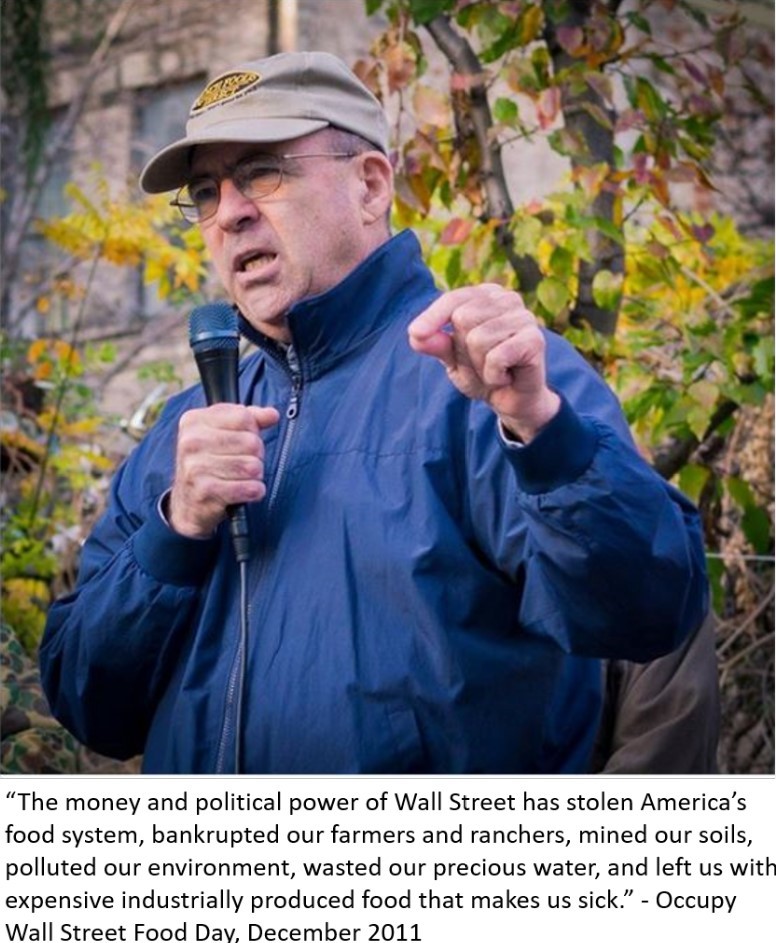 “The money and political power of Wall Street has stolen America’s food system, bankrupted our farmers and ranchers, mined our soils, polluted our environment, wasted our precious water, and left us with expensive industrially produced food that makes us sick.” – Occupy Wall Street Food Day, December 2011
How can an industrial livestock operation transition from feeding corporations to feeding people?
 Industrial Agriculture and Urban Sprawl – A model of growth that’s made to fail.

Ranching Reboot Episode 4, Mike Callicrate “It’s time for a third revolution against monopolies”
Above: Ranching Reboot – Episode 4 – Mike Callicrate, owner of Ranch Foods Direct, sat down with us to talk about all manner of things from cattle markets, to public food spaces, the Bander, his feedlot and the pathway he built to market.
He shares valuable lessons learned from fighting against the commodity production system and how he’s built his own pathway to the consumer.
We talk about small community slaughter plants and public meat spaces and what that could look like going in to the future. We discuss environmental challenges, the food police and what it means when a Dollar General comes to town.