Watch the meat you eat

Watch the meat you eat

MARCH 6, 2008

By RALPH ROUTON
Colorado Springs Independent

What does it take to scare America anymore? What does it take for everyday people, regardless of their politics, to unite in outrage? What does it take for the nation to demand the whole truth about an ominous, very real threat to our food supply?
Apparently, 143 million pounds of recalled beef isn’t enough.

Yes, 143 million, which computes to a plump hamburger for every living man, woman and child in the United States. All that meat considered not worthy for human consumption, not because of a mistake but simply because somebody ratted out Westland/Hallmark, a monster of the nation’s meat-packing industry.

It was serious news — for a week or so. But apparently, learning the all-too-typical practices of big companies isn’t enough. Not even the revelation that untold numbers of sick, weakened and crippled cattle — too frail to stand — have been shocked or pitch-forked to slaughter and processing.

Apparently, it didn’t matter that a lot of the recalled beef already has been eaten by America’s children, perhaps here in Colorado Springs. That’s because school districts everywhere buy “USDA surplus” beef. The assumption is that if the U.S. Department of Agriculture’s stamp is on it, in any form, the meat’s safe.

Never mind that your little Emily or Matthew might be eating a burger that includes ground-up cow brains, organs and even teeth.

What will it take? Hundreds of children dropping dead? Do we have to endure a national disaster?

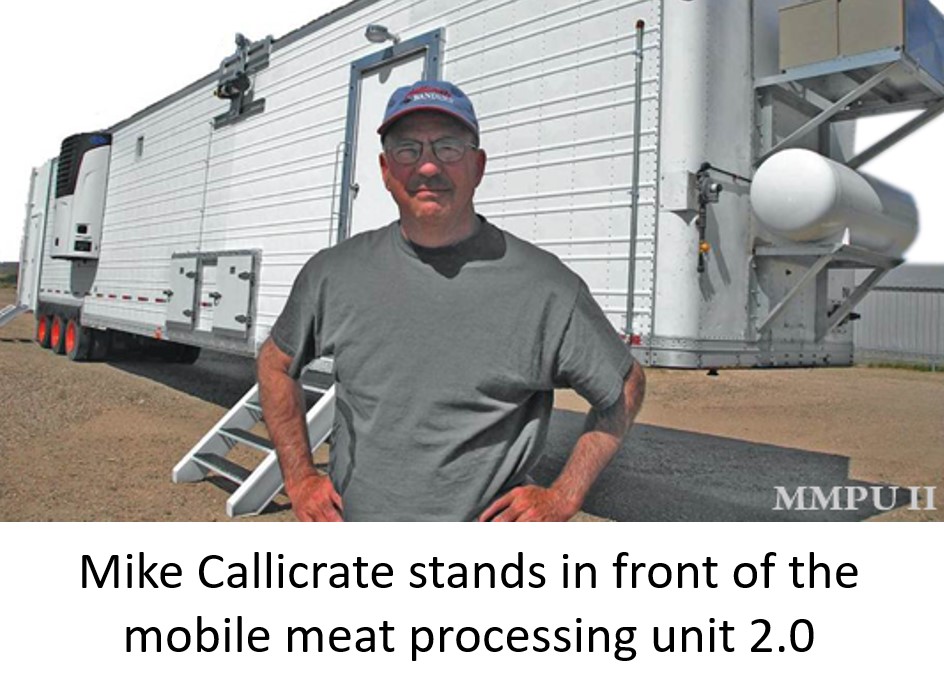
Mike Callicrate says he’s sickened by the latest news, but not surprised.

“It’s getting so bad, it’s unbelievable,” says Callicrate, owner of the local Ranch Foods Direct, longtime independent cattle producer and activist, and representative of those who understand the value of controlling all aspects of meat processing. “It’s amazing this wasn’t uncovered sooner, except nobody would believe it. This absolutely is the tip of the iceberg.”

Perhaps the biggest misconception, Callicrate says, is that the USDA really does inspect that beef you buy at the supermarket or eat at fast-food places.

“They’re not inspecting meat,” Callicrate says. “There might be inspectors at the big plants, but they’ve turned into paper-shufflers. If USDA inspectors can discover that an employee signed a form instead of initialing it, they’ll write it up. But if somebody picks up meat that’s fallen on the dirty floor and they put it into the grinder, the inspectors aren’t even in the room to see it.

“Companies are buying rejected, tainted meats. That ground-beef patty might be full of brain and spinal tissue from a cow that couldn’t walk, but it goes through. And the kids at school, or folks in the hospital or old-folks homes will get to eat it.”

Callicrate also is alarmed that one mega-company like Westland/Hallmark, the most recent culprit, can be exposed and the result is a recall of meat produced over a period of two years, affecting much of the country.

Lots of schools everywhere — some in this area, Callicrate says — get meat from Westland/Hallmark. Mammoth suppliers can offer low prices (Callicrate prefers the term “predatory pricing”) to schools and restaurants, and provide vegetables and produce as well. Those can be suspect, too, as in the colossal spinach recall of 2006 when one company’s tainted spinach caused illnesses in 26 states.

What can we do? If you have kids in school, Callicrate says, demand that your district be more accountable for the food it serves. Better yet, make your children’s lunches to take to school. And be more wary of what you buy.

It all comes down to trust. If you can’t be sure how your meat was handled, from the pasture to your plate, you should be concerned and demand the truth.

“We’re either going to have an industrialized food system in America,” Callicrate says, “or we’ll kick their ass [the USDA/Big Food partnership], make sure everyone buys local and get back to what really makes sense.”

There is some hope. Consumers are starting to come around, Callicrate says, buying more from farmers’ markets and local suppliers. They’re putting pressure on school districts, or packing lunches for their kids.

Yes, you have to be willing to pay more for meat and other food. But if you really care about your health, and what you eat, that’s your only choice.

— routon@csindy.com

Posted in General Advocacy | Leave a comment

Meat roulette – As the latest recall shows, food safety has taken a back seat to industry profits.

Meat roulette – As the latest recall shows, food safety has taken a back seat to industry profits.

http://www.latimes.com/news/opinion/commentary/la-oe-cook25feb25,0,5051181.story

From the Los Angeles Times

By Christopher D. Cook

February 25, 2008

Nauseating as it was, last week’s record-setting beef recall and the apparent feeding of meat from crippled “downer” cattle to our nation’s children and others should come as little surprise. Although egregious to the point of obscenity, this latest meat scandal fits a pattern of regulatory anemia — the byproduct of a decades-long bipartisan assault on “big government” — that has opened the floodgates to all sorts of contamination shenanigans. The deregulated chickens, cows and pigs have come home to roost.

Prompted by an undercover film from the Humane Society of the United States that shows workers kicking and shocking downer cows — cattle too sick to walk to their own slaughter — the Chino, Calif.-based Hallmark/Westland Meat Packing Co. recalled 143 million pounds of raw and frozen beef. (Stunningly, the government still lacks the legal authority to require food recalls — it can only recommend them).

Coming on the heels of 21 beef recalls in 2007, this latest meat fiasco was followed by predictable and inadequate responses by apologists and critics alike. U.S. Department of Agriculture officials — who, disturbingly, are charged with both promoting and monitoring our food supply — trotted out the standard “don’t worry, eat happy” line, even as they urged a recall. This signaled that our perilous game of meat roulette — a $70-billion-a-year business with phenomenal clout in Washington — would go largely unchallenged. Wayne Pacelle, president and chief executive of the Humane Society, criticized “the inadequacies of the inspection system. How can so many downers have been mistreated day after day within a USDA oversight system that was present at the plant? We need more boots on the ground at the plants.” Some in Congress are calling for a fuller investigation into regulatory lapses.

Clearly, more boots on the ground are vital. The USDA’s inspection squad has been trimmed by both political parties since the 1970s, plummeting to about 7,800 from 12,000 in 1978. Unannounced inspections have diminished to roughly 15,000 annually from more than 22,000. But merely beefing upregulatory staffing is like affixing a Band-Aid for a hemorrhage. The U.S. food safety crisis — in which, according to the Centers for Disease Control and Prevention, 76 million people get sick each year, of whom 325,000 are hospitalizedand more than 5,000 die — has roots of a more systemic nature.

Despite some recent declines in food-borne illnesses, the longer-term trend has seen soaring rates of salmonella, E. coli and other bacterial contamination since the 1970s (rising from under 20,000 reported salmonella poisonings in 1967 to more than 40,000 a year by the mid-1990s). Meat contamination has proliferated over the past 30 years along with the rise of industrialized feedlots and lightning-fast processing plants run by ever-fewer, ever-larger corporations.

The Hallmark recall must be viewed within the context of meat industry consolidation, which has seen four corporations control 83% of the nation’s beef production, according to the USDA. As the business has consolidated over 20 years, its clout in Washington has grown: witness the meat lobby’s continued successful opposition to universal testing for mad cow disease, its ability to coax regulators to speed up processing lines, and its effectiveness in reducing both the role and number of inspectors.

Both political parties have contaminated meat on their hands. Since rules set forth by the Reagan administration, line speeds for meat and poultry processing have been increased (from 78 chickens a minute to a dizzying 91 birds), threatening the safety of workers and consumers alike. In 1996, the Clinton administration struck a deal with the meat industry: a system that enhanced scientific guidelines for meat inspection while radically diminishing the presence of government inspectors on the production line. In affidavits, inspectors who cite problems have frequently reported being harassed and intimidated into silence by meat industry managers, and routinely relegated to evaluating company paperwork rather than monitoring the line.

Ultimately, what needs fixing goes far beyond recalling 143 million pounds of meat. We need to greatly expand the number and the role of food-safety inspectors; erect a stronger firewall between inspection and promotion, so the agency that sets line speeds and promotes productivity is not also charged with evaluating food safety; give the government full authority to require meat recalls and to identify where tainted meat has been shipped and sold; and slow the production line to enable more accurate inspection and greater care in handling the meat, which would also reduce the high worker injury rates. Finally, the extreme consolidation into a few corporate hands must be checked, to break the meat industry’s stranglehold on regulatory policy.

It’s time to put the health and well-being of America’s eaters, animals and food industry workers ahead of meat corporations’ desire for maximum profits and control.

Christopher D. Cook is the author of “Diet for a Dead Planet: Big Business and the Coming Food Crisis.” Website: www.christopherdcook.com. His work has appeared in Harper’s, The Economist, The Christian Science Monitor and elsewhere.

Posted in General Advocacy | Leave a comment

Humane Society Criticized in Meat Quality Scandal

Humane Society Criticized in Meat Quality Scandal

http://www.nytimes.com/2008/02/27/business/27food.html?_r=2&scp=1&sq=hallmark&st=nyt&oref=slogin&oref=slogin


Doug Mills/The New York Times
Gary Rodkin, left, chief of ConAgra Foods, at Tuesday’s House hearing, with B. Keith Shoemaker, president of Butterball L.L.C.

By ANDREW MARTIN
Published: February 27, 2008
WASHINGTON — As the meat industry scrambles to recover from a public-relations disaster over an undercover video of abused cattle, the secretary of agriculture and at least one congressman have picked an unlikely target to share in the blame: the Humane Society of the United States.

The Humane Society shot the video of what appear to be sick or lame cattle being forced to their feet with forklifts, hoses and electric prods at the Westland/Hallmark Meat Company in Chino, Calif., in October and November.

Released publicly in late January, the video touched off criticism of the Department of Agriculture’s inspection of the meat supply and led to the biggest beef recall in history, 143 million pounds.

At a hearing on Capitol Hill on Tuesday, Representative Michael C. Burgess, Republican of Texas, assailed the Humane Society for waiting to inform the federal government.

“Why wait until February to release the video?” Mr. Burgess demanded of a Humane Society representative. “Why wait until now to bring this to our attention?”

His criticism echoed a point made last week by Ed Schafer, the secretary of agriculture, who said he was “extremely disappointed” in the Humane Society. He complained that “for four months, theoretically, animals were not being properly treated, and the Humane Society stood by and allowed it to happen.”

Humane Society representatives said Tuesday that the criticism was misplaced. They said the primary concern of their organization is animal welfare, not food safety, and as soon as they had the tape they took it to local prosecutors in California.

The Humane Society said it was asked to withhold the tape while the prosecutors conducted an investigation. The society released the tape after growing frustrated with the pace of that investigation. Shortly afterward, prosecutors charged two slaughterhouse workers with violations.

The recall of meat from Westland/Hallmark has focused attention on potential food safety hazards, especially since some of the meat was served to schoolchildren. Slaughtering cattle that cannot walk, known as “downer” cattle, poses a slight risk of introducing disease into the food supply.

The Humane Society said its principal motivation in penetrating the slaughterhouse was to check whether Westland/Hallmark was treating animals in a humane manner.

“First and foremost, the U.S.D.A. should not be relying on a private animal welfare charity to do its job for them,” said Paul Shapiro, who oversees issues involving farm-animal abuse for the Humane Society. He said there was little incentive to go to the Department of Agriculture anyway because the agency often ignores abuse allegations.

Representative Rosa DeLauro, Democrat of Connecticut, said the Humane Society should be praised, not blamed, for uncovering the abuse and potential food safety problems at Westland/Hallmark.

“It is the height of irony that the U.S.D.A. is now trying to blame the whistle-blower for the agency’s own irresponsible behavior,” she said in an e-mail message.

Officials at Westland/Hallmark Meat declined to comment on Tuesday. Steve Mendell, the company’s president, refused to appear voluntarily at Tuesday’s Congressional hearing. The company has stopped operating, though whether the shutdown will be permanent remains to be seen.

Agriculture officials maintain that no one has become sick from the Westland/Hallmark meat, and that the risk of contracting mad cow disease from it is quite low.

The cattle in question had passed initial inspection by a Department of Agriculture veterinarian. But if cattle go down in the time between that inspection and slaughter, a federal veterinarian is supposed to be summoned to determine if they are fit. Whether that happened in every instance at Westland/Hallmark is at issue.

Dr. Michael Greger, director of public health and animal agriculture for the Humane Society, urged a subcommittee of the House Energy and Commerce Committee at Tuesday’s hearing to close the “loophole” that allows veterinarians to approved downed cattle for slaughter. He said that created a financial incentive for just the sort of abuse shown in the undercover videotape.

Several members of Congress on Tuesday bemoaned what they described as an underfinanced and antiquated food-safety system.

Robert E. Brackett, who served as director of the Food and Drug Administration’s food-safety unit until last year, criticized both the Bush administration and Congress, saying they failed to provide enough money to the agency to protect the food supply.

“Because F.D.A. food-related funding has not kept pace with inflation, more than 800 scientists, inspectors and other critical staff have been lost in the past four years,” said Mr. Brackett, now a vice president at the Grocery Manufacturers Association.

Posted in General Advocacy | Leave a comment

What can we learn from the Hallmark/Westland recall?

What can we learn from the Hallmark/Westland recall?

The news media wires are ablaze following the current 143 million lb recall. The timing could not be worse, realizing the chronic E.coli recalls and outbreaks which occurred throughout 2007. Filing charges against the noncompliant employees at Hallmark, and withdrawing inspectors from the plant merely place a band aid on a meat inspection system which is in dire need of serious transplant surgery. We are simply reaping the bounteous harvest resulting from the seeds sown by faulty HACCP protocol which has ruled the roost for the last nine years. In order to root out the bad seeds, we need to return to the grass roots of FSIS’ reasoning for mandating HACCP, perform a mid-stream evaluation, and discuss alternative solutions.

USDA/FSIS spokespeople participated in public training sessions for industry personnel in 1995, describing the goals the agency envisioned for the meat industry subsequent to the Jack In The Box debacle. The ugly JITB outbreak constituted justification for a radical departure in traditional agency inspection policies, and USDA embraced HACCP as the panacea for addressing modern-day pathogens. The agency had a gargantuan marketing task on their hands: convince the entire industry it must voluntarily embrace and implement a new meat production system. No easy task. FSIS authored numerous HACCP foundational beliefs and dangled them in front of the industry; delectable morsels intended to entice the industry to support the agency’s newest regimen. FSIS statements included the following:

1. HACCP is superior to the previous meat inspection system, because HACCP is “science based”. When pressed on this issue, the agency stated that the foundation for a science-based system is microbiological testing, which would be a major component of HACCP. USDA stated that both the agency and plants would commence collecting a substantial number of microbial tests. The agency admitted that its previous system had been “organoleptic” in nature, meaning sensory, such as sight, smell, touch, etc. The previous system began to be characterized as “poke and sniff”, which allegedly could not detect the E.coli causing the JITB outbreak. Much attention was given to the fact that E.coli was a relatively new pathogen, and that bacteria do mutate and evolve, requiring a microbial testing program to detect these invisible bacteria.

2. Each plant must write its own HACCP Plan. Since no two plants are identical, no two HACCP Plans would be identical either. And, the agency publicly stated that it could not tell plants how to write their HACCP Plans.

3. Under HACCP, USDA would disband its previous command & control authority.

4. Under HACCP, USDA would no longer police the plants. Plants must now police themselves.

5. Under the HACCP umbrella, USDA’s role would be “Hands Off”.

The beleaguered industry swallowed these agency promises hook, line and sinker. The ability to self-police in this newly-deregulated industry constituted sugar plums dancing in our heads. Seeds were being sown.

The Federal Meat Inspection Act was enacted in 1906, largely because the pre-1906 slaughter houses abjectly failed in policing themselves. In less than 100 years, USDA unilaterally and voluntarily relinquished much of its authority while intent on repeating history. But think of the beauty of HACCP in the eyes of FSIS: whenever outbreaks and recalls occur, how can the agency be even partially liable for the presence of bad meat which it had never inspected? HACCP allowed the agency to slide into semi-retirement, while simultaneously shielding it from accountability. The official USDA Mark of Inspection states “USDA Inspected and Passed Est. # xxxx”. Passed indeed, but frequently not inspected.

On January 26, 1998, the largest plants implemented HACCP. On February 1, 1998, FSIS issued Directive 10,010.1 which exempted qualified large plants from agency-conducted microbiological testing. In a mere six days, FSIS rewarded the large slaughter plants for their voluntary implementation of deregulation. This gift benefited more than just the big packers. Since the agency was now relieved of its duty to test, it would no longer experience any lab positives, sparing it from the uncomfortable task of bringing enforcement actions against the big slaughter facilities which had been promised the agency would embrace a “Hands Off” status, gratis HACCP.

FSIS declared E.coli to be an adulterant, in ground beef as well as in boneless trimmings. However, “science” prohibited classifying E.coli as being an adulterant when found as surface contamination on boxed beef cuts. Therefore, when boxed beef contaminated with E.coli subsequently caused e.coli sicknesses, the slaughter plants were not liable for the sicknesses. The justification for this decision is that the slaughter plants state that the boxed beef “is not intended for grinding”. The agency whole-heartedly endorsed this claim by the large slaughter facilities, and exposed their willingness to bury its head in the sand. Further processors have always had the right to grind trimmings emanating from processing of boxed beef, and in fact it is a financial necessity. Furthermore, realizing that the trimmings emanated from carcasses whose wholesomeness had been validated by HACCP protocol at the slaughter plants, boxed beef produced from those wholesome carcasses must also be wholesome, as attested to by the official USDA Mark of Inspection on the incoming boxes of boxed beef.

While FSIS has provided lip service to and endorsement of traceback policies in numerous agency publications, agency policies have been written to prevent tracebacks to the slaughterhouse origins of contamination from enteric bacteria. For example, when FSIS inspectors collect samples of ground beef for microbial testing at USDA labs, the inspectors are prohibited from documenting the origin of the meat being tested at the time of sample collection. Instead, if the test comes back positive for E.coli four or more days later, only then does the inspector collect evidence from plant management. By this time, the trail of evidence has turned cold, and plant management can provide any “evidence” it desires. The agency lacks the ability to independently validate the accuracy of provided evidence. The flip side of the coin is equally heinous. In the absence of evidence, FSIS feels free to flex its muscles and assesses all liability against the downline further processing plant for the presence of enteric bacteria at their establishment, even though the establishments more often than not do not slaughter. Again, planting seeds of future outbreaks. The intentional delay in documenting evidence is not indicative of a truly “science-based” system, and dismays true scientists. This constitutes an agency-endorsed artificial restriction on complete scientific procedures when public health is at risk.

Two of the foundational legs on which HACCP was constructed are (a) Preventive Actions, accomplished via the plant’s Hazard Analysis and the establishment of appropriate Critical Limits, Critical Control Points, SOP’s, SSOP’s, Pre-Requisite Plans, etc, and (b) Corrective Actions to be taken on those rare events when food safety problems occur. A close review of the majority of corrective actions and HACCP reassessments subsequent to pathogen outbreaks and recalls clearly indicate that FSIS does not require corrective actions at the SOURCE of contamination, but rather at the downline DESTINATION of previously contaminated meat. More seeds being sown for future outbreak harvests. The agency’s chronic failure to traceback to the origin of contamination continually insulates the origin from enforcement actions, endorses the source plants’ operations, and guarantees future recurrences, while hagriding the innocent downline destination plants.

FSIS’ typical response to public revelations such as the current Hallmark/Westland problem and the recurring E.coli problems in 2007 has been the production of numerous additional Notices and Directives, all designed to portray the agency as the consuming public’s best friend. FSIS policy makers do not realize that a flow of words is not proof of wisdom………or sincerity. Notice 65-07 is but the latest in a long parade of agency proclamations which are intentionally designed to torment and harass small downline plants and assess all liability against them, while removing agency focus from the large slaughter establishments. Risk Based Inspection is another example of “a lot to do about nothing”.

Revelation of systemic agency abhorrence of unbiased, truly science-based meat inspection policies could fill a book. What is more difficult is authoring science based AND common sense resolutions to this unnecessary circumvention of basic scientific protocol. The following suggestions constitute a substantial starting point in the promotion of science, while protecting public health.

First of all, progress would indeed have been made if the previous organoleptic system had been maintained, COUPLED WITH substantial microbial testing. HACCP threw out the baby with the bath water. HACCP Plans still provide “potential” benefits, but not when they result in passing all liability downstream with the previously-contaminated meat. God gave us the sense of sight, smell, feel etc, so let’s use them. To claim that our organoleptic senses provide no benefit in a meat inspection system is akin to the tried and failed “new math” system of a few decades ago.

FSIS must author policies which not only allow, but in fact mandate tracebacks to the ORIGIN of contamination. Granted, when bad meat is detected already in commerce via public health outbreaks, the ability to traceback to the origin is more difficult. But, when bad meat is discovered in a plant or via lab test results, a conclusive and expeditious determination of the source is possible, if only FSIS could summon up the courage to fulfill this vital task.

Command and control must be returned to FSIS. More than one OIG investigative report concluded that USDA’s implementation of HACCP had reduced its oversight short of what was prudent and necessary for the protection of the consumer, and that inspection personnel did not know what authority they had. Concurrently, a well-defined and thoroughly-explained FSIS policy must be authored which allows aggrieved companies the right to appeal the actions of agency personnel who sometimes exceed their lawful authority, AND the right to legal recourse in civil proceedings.

FSIS must commence a substantial increase of microbial testing at all plants, with the highest increase occurring at slaughter facilities of all sizes. Testing at slaughter plants should be done on carcasses, trimmings, ground beef, AND boxed beef. In recent years FSIS repeatedly has stated that it desires to be open and transparent in all its dealings, and that the industry must embrace “robust” testing protocol. In light of this, all lab results of agency-conducted testing must be posted on a web site available to all, in real time. Indeed, now is the time for sincere transparency.

FSIS must request substantial new funding from Congress to hire more inspectors, and to fund a dramatic increase in testing. There could not be a better time than now to request increased funding, since the agency and our industry have been under media assault for more than a year……..for good reason.

Was the Hallmark/Westland failure caused by, or enabled by FSIS “Hands Off” policies? Whether yes or no, an aggressive agency acceptance of a “Hands On” policy would reduce future recurrences.

Rather than continually harvesting what HACCP’s seeds have sown, let’s perform some genetic modification of HACCP, conduct open heart surgery, and require FSIS to return to a “Hands On” inspection status.

We must jettison the current meat inspection system which was established to benefit FSIS and the large slaughter plants, and replace it with a meat inspection system solely designed to benefit the goals of public health and safe food.

Some industries may respond well to deregulation and self-policing. The food industry is NOT one of them.

Respectfully submitted by John Munsell, this 19th day of February, 2008.

Posted in General Advocacy | Leave a comment

Worn-out dairy cows reflect industrial agriculture’s failings

Worn-out dairy cows reflect industrial agriculture’s failings

By Mike Callicrate

Once again America and the world are shocked at the extent business will go to make money. And I don’t just mean the inhumane treatment of cows and the resulting record recall of 143 million pounds of beef. We aren’t happy with the amount of milk a normal cow produces. Growth promotants, production boosting hormones, antibiotics and all other forms of cost-reducing profit-enhancing technology is never enough.

Today’s highly concentrated and consolidated food system is dominated by huge multinational corporations that aren’t happy with the profit normal animals, humans and the earth will provide. The desperation of small operators is palpable as these modern Robber Barons sit fat and happy in their office suites looking down on the lowly highly disadvantaged independent competitors. The marketplace is so demanding and predatory that small and medium sized companies have little hope of surviving even with corner cutting and/or resorting to outright cheating.

Milking the system
The Bible instructs us to care for our animals, “A righteous man respects the life of his animal.” Our cows tell the ugly and sad story. A cow that once gave milk over a period of eight or more years is now, with the use of Monsanto’s rBGH hormone and aggressive hot feed rations, often used up after three years. The weak remains of this completely drained animal milking machine is then ground into our school lunches, fed to recovering patients in hospitals and nursing homes and further distributed through food service companies into restaurant and other institutional trade. This cheap meat is used by big food service companies to drive producers of good, healthy and safe local beef out of business.

No one is better off except the big food and chemical corporations. Desperation is seen in the way both humans and animals are treated. Our food system is like the coal mines and miners of Appalachia – family farm agriculture and small processors are being strip-mined out of business as the enormous wealth created from their labor and land is stolen by Tyson, Cargill, ConAgra, Swift, Monsanto and their big retail partners. Our nation’s future health and well-being is at stake.

Recalling the beef while eliminating the competition
USDA as a wholly owned subsidiary of the big food cartel is not the people’s agency that President Lincoln envisioned. Isn’t it interesting how the well publicized food recalls negatively affect the smaller plants most? What would this week’s beef recall have looked like had the inhumane treatment been videoed at one of the major plants, which by the way have tight security preventing such embarrassments? Many of the large national recalls have resulted in the elimination of smaller plants like Hudson and Topps, causing further consolidation of our food system into fewer and fewer hands.

USDA cops are in the pocket of the criminals
Obviously we aren’t happy with the job USDA is doing in protecting our food supply. However, what many don’t realize is the USDA is also responsible for making sure the marketplace is fair and competitive, giving us good choices as to where we buy our food.

USDA has abdicated their responsibility for enforcing the antitrust laws that were designed to protect the producers of our food from unfair business practices, thereby protecting all of us from monopoly control over what we eat. One hundred years ago Congress agreed that we are best served by a family farm and ranch food system with many buyers and sellers serving the best interests of consumers, not a system controlled by the Robber Barons that we have today. What physical and mental toll does it take on the management and labor of small and medium sized companies when they get up every morning facing the life threatening predators of big food? We see the anxiety in the lack of dignity and respect shown to others and to the animals that provide our food.

Bigger is not better
The relatively modern “bigger is better” experiment in agriculture and food, also known of as industrial agriculture, has been a complete disaster. The economy of scale and efficiency lies have been propagated throughout our corporate controlled universities and government agencies since before the days of Agriculture Secretary Earl Butz. Industrialization has been mandated through government policy, driving farm and ranch families off the land and into the cities to do “more productive work”. Like in Appalachia, this industrial model is mining, rather than nurturing our land, people and communities, leaving a wasteland of broken rural towns and dead dirt. Dan Glickman was asked during his term as Ag Secretary why USDA didn’t enforce the antitrust laws from the early 1900’s protecting independent producers and our marketplace. He said, “It’s different this time. We are trading in a global market, we need big companies that can do business globally.”

Let’s not allow the serious and totally unacceptable problems that have been exposed in the past couple weeks to push us closer to an even more dangerous food system – one controlled more and more by big food and a corrupt USDA.

Mike Callicrate is an independent cattle producer, business entrepreneur and political activist, particularly outspoken in addressing the rural and social impacts of current economic trends.

Posted in General Advocacy | Leave a comment