From Banks to Bread – Deregulation is The Seed of Destruction

From Banks to Bread – Deregulation is The Seed of Destruction

By Mike Callicrate

Our economy is reeling from the failures of government to properly regulate business and enforce anti-trust laws. The liars, cheaters and thieves who have already made a killing are poised to make off with even more by way of a federal “rescue plan.”

For many years we have been told that Wall Street is “The Economy,” only to get a harsh reminder that it’s really Main Street, our farms, ranches and our manufacturers that produce our wealth. How absurd is it that we are now expected to save the very Wall Street predators that have preyed on the real businesses and working people of Middle America.

A fundamental premise of our founding fathers was to avoid the concentration of political and market power as they had witnessed in the combination of the British Crown and the East India Company. Even Adam Smith, at the time, was advocating good ethics and warned against monopoly. Widely dispersed competitive markets with many buyers and sellers competing for and demanding goods and services was considered the best for serving the public good. The no-rules-bigger-is-better business mentality of the last 28 years, beginning with President Reagan and the deregulation of the savings and loans has left us bankrupt of both good ethics and dollars. “Too-big-to-fail” companies now hold tax payers and Congress hostage.

Today, as we are experiencing the meltdown of Wall Street, we are ignoring a similar state of dysfunction that’s been allowed to develop in our food system. Our government — courtesy of rogue Agriculture and Justice departments — has facilitated the alarming takeover of the food and agriculture industry by a handful of very large multinational companies.

It is unbelievable that, even as the Wall Street debacle unfolds, our Justice department would consider approving the Brazilian takeover of two more of our U.S. meatpackers, allowing this foreign entity — partially owned by the Brazilian government — which already owns the third largest U.S. meat packer, to become the biggest processor of beef in the U.S. and the world.

Apparently we haven’t learned anything from becoming dependent on foreign oil, as we are now unable to feed ourselves.

Following is a troubling film about Monsanto, offering more evidence of what happens when government fails to act on behalf of consumers and the general public. Monsanto now controls about 80% percent of the U.S. field crops.

Monsanto is only the tip of the iceberg. Every sector of our food system is too highly concentrated and in the position to threaten literal starvation if they fail.

Please view the following video for an eye-opening experience:

The de-reg Reagan administration cleared the way for monopoly power.

The World According to Monsanto – See film

Roughly 27 minutes into the film, in response to a Monsanto employee expressing the need for fast approval of their genetically modified technology, then Vice President George Bush says, “Call me, we are in the ‘de-reg’ business. Maybe we can help.”

Following that comment, listen as another former vice president, Dan Quail, refers to the president’s “regulatory relief initiative,” part of an effort to “resist the spread of unnecessary regulation.”

Posted in General Advocacy | Leave a comment

Upton Sinclair Award Dinner – Change. Not Charity

4-4-08 Sinclair and socialism

Apr 8, 2008 2:00 PM

Mike Callicrate’s letter in the March 7 Colorado Catholic Herald presented a view of American society I do not share. His letter is a paean to the movie “There Will Be Blood,” the screenplay based upon the novel “Oil!” by Upton Sinclair.

Upton Sinclair was not only a prolific writer; he was also a strong advocate of socialist views. He founded a socialist commune, Helicon Hall Colony, in 1906. He ran for the U.S. Congress on the Socialist ticket three times. Sinclair was noted for his muckraking style of writing. The main goal of his novel the “The Jungle” was to demonstrate the inhumane conditions of the wageearner under capitalism, not to inspire reforms in how the meatpacking was done.

Callicrate’s view of America is clear by his words: “we are back to the days when profit and power were valued at all costs over people,” “a no-holds-barred arena with such dominating and perverse power,” “an unhealthy obsession with money and power,” “our ruthless big business/government will not rest until it finishes wrecking our country.” I disagree with his unsubstantiated statements. Callicrate’s opinion of our capitalist socioeconomic system is not accurate.

Catholics should be wary of socialism. Countries which have drifted to socialism have not been kind to our faith as evidenced by the current situation in Venezuela. America is the most generous nation in the world and its workers have a standard of living most can only dream of.

Jim Lynch

Colorado Springs

————

4-16-08

We can label people and governments as socialist, fascist or democratic, but the real question to me is this: do people have the basic rights to economic freedom, equal opportunity and social justice? Today, the relationship between government and big business is far too cozy. The business interests of Wall Street trump the interests of Main Street. Unfortunately, what is good for Wal-Mart, GM, or Exxon, is not necessarily good for America as a whole. Too many of the laws policing the spectrum from domestic business to international trade policy are written and enforced in the interests of large multinational corporations and at the expense of small independent businesses and producers.

Remember that capitalism is a broad term, and what passes for capitalism today is different from the version that inspired our nation. Catholic philosopher G. K. Chesterton said, “Big Business and State Socialism are very much alike, especially Big Business.” — G.K.’s Weekly (4/10/26). He also said “Business, especially big business, is now organized like an army. It is, as some would say, a sort of mild militarism without bloodshed; as I say, a militarism without the military virtues.”

G. K. Chesterton’s Distributism: [audio:http://nobullmikecall.wpengine.com/wp-content/uploads/2012/08/10-19-11DaleAhlquistDistributism.MP3]

Mr. Lynch is right about Upton Sinclair. When uncovering big meatpacker abuses he got the public’s attention, not by triggering their empathy for the abused workers and animals but with the threat of dirty food and the danger to their own health. What has changed from 100 years ago? The meat packing industry is far more concentrated than it was a century ago with four beef packers controlling over 80% of the market. Unsafe food is a huge problem. Recently 143 million pounds of beef were recalled after being shipped all across the nation to schools, churches, hospitals and senior centers. Meanwhile, the big meatpackers depend on cheap labor from the world’s economic refugees. According to the United Food and Commercial Workers Union, a supervisor must speak around 18 different languages in order to communicate in the typical big meatpacking plant.

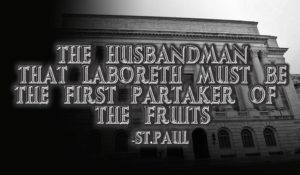
I don’t think St. Paul was a socialist in the way we think of the former Soviet regime, but in 1 Timothy 5:18 he stated, “The husbandman that laboreth must be the first partaker of the fruits.” These very words appear over the portico of the U.S. Department of Agriculture headquarters in Washington, D.C. But sadly, it’s hard to see how this goal has been applied to modern food and farm policies when thousands of farmers go out of business every month.

In his new book, Free Lunch: How the Wealthiest Americans Enrich Themselves at Government Expense (and Stick You with the Bill), David Cay Johnston, long-time reporter for The New York Times states, “A system in which government, whether federal or local, picks the winners in the economy, is not capitalism, it’s not competition, it’s not free market, it is corporate socialism, it is statism, it’s the state making these choices.”

Don’t assume concerns for a vibrant, just economy are partisan views. Our founding fathers, Benjamin Franklin and Thomas Jefferson, along with U.S. presidents from Abraham Lincoln to Teddy Roosevelt, all warned of the dangers of corporations and the concentration of power and wealth into the hands of a few. Franklin Delano Roosevelt said it well: “The liberty of a democracy is not safe if the people tolerate the growth of private power to a point where it becomes stronger than their democratic state itself. That, in its essence, is fascism – ownership of government by an individual, by a group, or any controlling private power.”

I think most Americans can agree that a centrally planned economy like the former Soviet Union, controlled by a few individuals — or a centrally planned government controlled by few corporations — does not deliver the basic rights of economic freedom, equal opportunity and social justice. We don’t have to look far to see evidence of abusive corporate power over our current politics and economy.

I want to thank Mr. Lynch for sharing his comments and for the opportunity to further discuss the important issue of corporate concentration.

Mike Callicrate

Posted in General Advocacy | Leave a comment

Upton Sinclair – School Lunch

Posted in General Advocacy | Leave a comment

DesMoines Register – Inspectors didn’t catch cattle abuse in California – Cartoon from Philadelphia Inquirer

DesMoines Register – Inspectors didn’t catch cattle abuse in California – Cartoon from Philadelphia Inquirer

March 23, 2008

By PHILIP BRASHER
Register Washington Bureau

Washington, D.C. — The undercover videos were bad enough: packing-plant workers abusing sick or disabled cattle and dragging at least one of the cows to be slaughtered, a violation of federal food-safety standards.

But consumer advocates say what’s also disturbing is what happened within days of that video being shot at a California slaughterhouse. Independent inspectors from two auditing firms visited the Westland/Hallmark Meat Co. plant and gave it glowing marks.

Companies from McDonald’s to Wal-Mart are increasingly relying on similar third-party inspections to assure the public that the meat, produce and other food they are eating was properly raised and processed.

But the misleading reports from the Westland/Hallmark plant are prompting questions about how meaningful these audits really are. The Humane Society of the United States, whose undercover investigator shot the video that led to the largest beef recall in U.S. history, said Westland/Hallmark coached workers on safe-handling practices a day before one auditor visited the plant.

Some packers — including Tyson, which has Iowa plants — may install cameras to monitor workers handling livestock.

Meanwhile, federal inspectors are temporarily spending more time watching how livestock are handled at packing plants, including three in Iowa, and less time checking the meat.
Plant scored high in two inspections
Independent inspectors from auditing firms based in Virgina and Illinois both missed the livestock abuse at the Westland/Hallmark’s Chino slaughterhouse that resulted in the plant’s entire production for the past two years – 143 million pounds – being recalled.

The vice president of HACCP Consulting Group, a Virginia-based auditing firm, inspected the California plant last Nov. 13-14 and reported that it had a well-designed humane-handling program “to ensure that live animals are treated in a manner conducive to the tenets of established humane-handling practices.”

A week later, a representative of an Illinois-based auditing firm, Silliker Inc., graded the plant’s humane-handling practices according to an audit system that’s in wide use through out the meatpacking industry.

The plant received 106 out of a possible 110 points, including perfect scores on the condition of the cattle and the way they were unloaded and treated in holding pens.

How could a plant treat cattle poorly – the company president says he was sickened by what he saw on the videos – and yet pass its outside inspections with no problem?

One possible explanation is that the company knew the auditors were coming and cleaned up its act.

On Nov. 12, the day before the HACCP Consulting Group representative reviewer visited the plant, the workers who handled cattle were called together and lectured in Spanish for an hour on the proper way to treat the livestock, said Wayne Pacelle, president of the Humane Society of the United States.

Among the workers was the undercover investigator for the Humane Society of the United States who had been shooting the now-famous video over the previous six weeks, Pacelle said.

John H. Miller, the HACCP Consulting Group inspector, said company officials were “quite proud” of their practices. From “what I saw when I was there, they had a right to be,” he said.

Miller, a former federal meat inspector, said HACCP’s audit had been scheduled in advance with the company.

The other auditing firm, Silliker, declined to comment, citing client confidentiality.

Doing unscheduled audits wouldn’t necessarily make a difference, said Temple Grandin, a consultant who designed the humane- handling auditing program that is now the industry standard. As soon as an auditor enters a plant gate, supervisors have plenty of time to warn workers what is coming, she said.

“Some plants are very clever to make sure they don’t do bad things when the auditors are around,” she said.

She said she believes it’s time for slaughter plants to start installing cameras in pen areas so that there is a video record of what’s happening.

Having the videos would not only ensure that workers are doing what they’re supposed to be doing, but also protect the company in case there’s a dispute with an on-site government inspector, she said. The companies could bring in an outside expert to view the video and referee the dispute, she said.

Some companies are looking into camera systems for livestock-handling areas in the wake of the Westland/Hallmark case. Tyson Foods Inc. has cameras in the processing areas of its plants in Iowa and elsewhere, but the company has not decided whether to place cameras in livestock yards, said spokesman Gary Mickelson.

The National Meat Association, an industry trade group, held a conference call Wednesday for representatives of its member companies to discuss the installation of cameras at their plants.

“Nobody wants to be the next Westland/Hallmark and get caught by surprise like that,” said Jeremy Russell, the association’s director of communications and community relations.
New USDA emphasis on livestock handling
The use of independent audits “isn’t the best way to ensure that the public is well-protected,” according to Chris Waldrop of Consumer Federation of America.

“The audits can definitely be a problem, because the company … for the most part knows exactly when (the auditors) are coming and can adjust their procedures accordingly,” Waldrop said. “You’ve got to have the federal and state governments involved, as well.”

Under an order the U.S. Agriculture Department issued March 10, inspectors are to spend 50 to 100 percent more time on humane-handling issues than they normally do, until May 6.

The shift in inspection priorities is most pronounced in plants that supply the federal school lunch program and in facilities that slaughter older cattle. If inspectors in those plants normally spent an hour and half daily on livestock-handling issues, they will now spend three hours a day.

The three Iowa facilities that supply the school lunch program are the Farmland and Swift plants in Denison and Marshalltown that slaughter pigs and a Tyson Foods beef plant in Denison.

The order followed allegations that sick or dying cattle were being slaughtered at the Westland/Hallmark plant, which was one of the largest suppliers for the national school lunch program. The facility primarily slaughtered older dairy cows, but packers generally are banned from slaughtering cattle that can’t walk because of the slight risk that they could carry mad cow disease.

USDA officials say they want to ensure that similar problems are not occurring elsewhere.

The USDA will continue to inspect each carcass, as required by law, but will prioritize other work based upon the relative food-safety risk of the product, said spokeswoman Amanda Eamich.

“We’re not going to sacrifice food safety,” she said.

USDA officials have assured the public that what happened at the California plant was an “isolated incident of egregious violations.”

Reporter Philip Brasher can be reached at (202) 906-8138 and pbrasher@dmreg.com

Posted in General Advocacy | Leave a comment

School makes switch to organic beef

School makes switch to organic beef

Jim Myers
Mar 7, 2008 9:00 AM

Angela Harder (left) and Denise Wojcik prepare hamburgers using natural beef at Corpus Christi School on March 3. Herald/Esperanza Griffith
COLORADO SPRINGS. Corpus Christi School has changed beef suppliers to a local organic outlet following a U.S. Department of Agriculture (UDSA) recall of beef in the middle of February at institutions around the nation.

The recall, the largest in U.S. history that aimed to round up 143 million pounds of suspect meat, came on the heels of an investigation of California-based Hallmark/Westland Meat Packing Company. The slaughterhouse and grinding operation that supplies approximately 20 percent of the lunch meat to schools across the nation has come under investigation for inhumane and potentially dangerous practices.

Corpus Christi participates in a government lunch program that provides meat and other food supplies that public and private schools can use in hot lunches. Corpus Christi is one of four diocesan schools, along with Ave Maria in Parker and Divine Redeemer and Pauline Memorial in Colorado Springs, which provides hot lunches to students on a daily basis. St. Peter in Monument provides hot lunch one day a week.

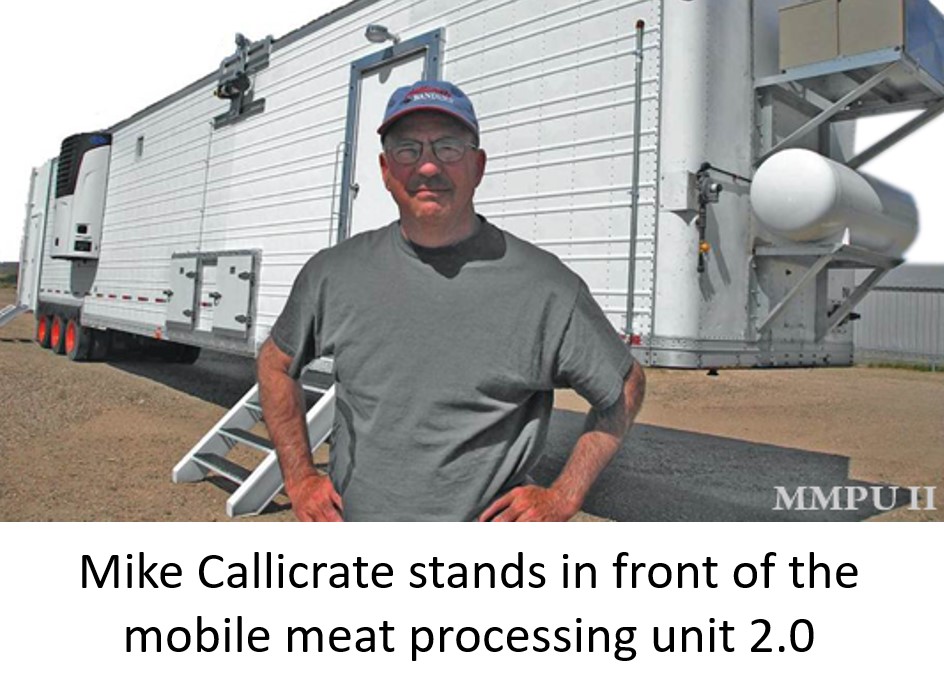
Corpus Christi now is using Callicrate Beef, a local brand that is sold at Ranch Foods Direct in Colorado Springs. Callicrate Beef and Ranch Foods Direct are owned by Mike Callicrate, a Catholic who makes his home in St. Francis, Kan., and commutes back and forth to Colorado Springs weekly.

According to the Office of Total Catholic Education, Divine Redeemer contracts lunches through District 11, which receives its beef from Callicrate Beef. Ave Maria works in concert with Douglas County Schools, which is in talks with Callicrate Beef to become a food supplier.

Callicrate said Callicrate Beef and Ranch Foods Direct operate with an understanding of humane treatment of animals, and his company adds no hormones, antibiotics or animal by-products to its meat. He said inhumane treatment of livestock extends to unhealthy food preparation and a substandard finished product that shouldn’t be served to children at schools or aging people in assisted living facilities.

“We have companies that have taken food and turned it into something unhealthy,” said Callicrate, referring to additives and chemicals that are put into processed foods. “We’re treating our children and old people in ways that are unacceptable. Did your mom and dad simply feed you with the cheapest thing they could find?”

Further, from a Catholic perspective, human and ethical meat production follows the call for stewardship of the earth, Callicrate said, calling it “morally wrong” to simply take from the land indiscriminately.

“We are instructed to care for our animals humanely,” said Callicrate. “We are instructed to treat people the way we want to be treated.”

The beef recall stems from producers like Hallmark/Westland, which were using “downer” cows for beef supply. Downer cows are cattle that are sick, diseased and dying. They produce meat that may be detrimental to humans if ingested. Hallmark/Westland is accused of grinding downer cows into ground beef, including grinding spinal cords into the product.

“Of the 143 million pounds involved with this recall, we have about 50.3 million pounds that went to federal nutrition programs,” Eric Steiner, associate administrator for the USDA’s food and nutrition services’ special nutrition programs, told reporters in a teleconference Feb. 21. “Of that 50.3 million pounds, we have 19.6 million pounds that were consumed.”

The USDA listed the beef recall as a Class II recall, indicating a low health risk, and no illnesses have been reported from tainted meat.

“[W]e call it a very, very remote probability of any adverse illness,” said Dr. Kenneth Peterson, assistant administrator for the USDA’s food safety and inspection service’s office of field operations.

Rina Sanabria, food services coordinator at Corpus Christi, said the school was surprised to find out it was getting suspect beef for its school lunches, though she said no students reported becoming sick from any tainted meat.

“Coming from the government, you would think they were sending us good things,” she said. “I was very concerned because we’ve been getting this meat for a long time.”

The USDA contacted Corpus Christi in February and told the school to put beef on hold and not to use it. The school sent all its government beef back in the middle of that month and plans to use Callicrate Beef as its sole beef provider moving forward.

Sanabria said cafeteria staff had been asking her before the recall if the school could switch to Callicrate Beef. She didn’t know if Corpus Christi could afford the company, but she said the school got a good deal to receive ground beef and patties from Callicrate Beef.

“The ladies that work here, they don’t eat anything but Ranch Foods Direct,” said Sanabria, who is a member of Corpus Christi Parish.

Callicrate said parents need to hold schools accountable for what goes into students’ lunches.

“Parents have to stand up and say, ‘I want my child to have better food at school,’” said Callicrate, noting that parents should be prepared to stand their ground and expect arguments that increased quality means increased costs. “The bottom line is this industrialized model of agriculture has managed to externalize a lot of the costs: costs of a living wage, environmental costs, losing our domestic food system. Parents have to be willing to stand up and say that they will not pay for fake, industrialized food.”

Sanabria said the school let parents know in its weekly newsletter that Callicrate Beef was the new supplier. She reported that several students who previously did not get hot lunches at the school have begun ordering meals.

According to Callicrate, cheap, processed food takes a toll on a child’s learning ability, and he lamented the fact that children are given unhealthy food and expected to perform at a high academic level.

“When we send our kids off to school with a Mountain Dew and Snickers bar, it’s not cutting it. We’ve got to get them back to whole foods,” said Callicrate, noting that many cafeterias are serving processed ready-to-eat meals rather than having lunchroom staffs that can prepare hot meals from scratch.

Sanabria said she feels confident that children are now getting high-quality beef for hot lunches, and that she has removed the burden of concern about tainted meat.

“I love these kids, and I don’t want any of them getting sick. Now I don’t have to worry about that,” she said.

RSS News Feed

© 2008 Diocese of Colorado Springs. Bishop Michael J. Sheridan, Publisher. Bill Howard, Editor. Colorado Catholic Herald Online was established March 17, 2006. The Colorado Catholic Herald is the official newspaper of the Diocese of Colorado Springs.

Posted in General Advocacy | Leave a comment