An Open Letter to National Cattlemen’s Beef Association Leadership

August 30, 2002

An Open Letter to National Cattlemen’s Beef Association Leadership

Dear Wythe Willey, NCBA President; Eric Davis, President Elect; Jan Lyons, Vice President; and Terry Stokes, CEO:

After reading your open letter to cattlemen, it is clear that you still don’t get it. You continue your haughty hard line stance of no government intervention. Do you suggest the same no-law-enforcement policy for drunk drivers? Are you suggesting our markets don’t need protection from those who would eliminate them? Does NCBA not see a roll for government in stopping the economic raping of the cattlemen you claim to represent? Do you suggest that every cattlemen who is unable to market his livestock, enter the “free” market and build their own packing house and retail outlet in competiton with Tyson/IBP and Wal-Mart?

Your model of  no-rules “free trade” is bankrupting entire countries, reducing U.S. communities to ghettos and returning the U.S. to colony status. No country can survive exporting below cost of production while at the same time acting as a dumping ground?  Last year the U.S. posted over a third of a trillion dollar trade deficit. Global corporations are becoming our quasi government. They are sucking us and other nations dry, enslaving us as their tenants under their shared kingship. Our economy is rapidly heading in the same direction as Argentina’s as you plan your self-promoting town hall brainwashing sessions.

You continue to block good legislation. You recently helped defeat the competition title in the farm bill, which would have provided better market access and more choices for livestock producers. Instead, you supported a farm bill that fails to restore competition and fair distribution of the consumer food dollar. You supported a farm bill that makes farms more dependent on the government by guaranteeing oversupply and low grain prices…bad for farmers and tax payers, but good for packers who own and control their captive-supply livestock, and retailers who want to increase their profits.

You fought mandatory price reporting. When you and your colleague, American Meat Institute, representing big packing and processing failed to block the legislation, you and your former corporate friends within USDA still prevailed with an underhanded, backroom writing of the rules, effectively reversing the intent of the law. Because of the confidentiality provision, we now have price reporting without price information. Far less price information is available now than ever before.  You are implementing the same deceitful strategy with country of origin labeling.  Your packer/processor/retailer bosses want cheaper imports and they don’t want the consumer to know where the meat came from.  It now appears that your scheming will result in approximately half of the imported beef going unlabeled – another example of reversing the intent of good legislation and rejecting the wants of consumers.

Unlike NCBA, I am in the trenches everyday facing the abusive packer/retailer cartel that you call your allied partner.  I see first hand the looting of our communities.
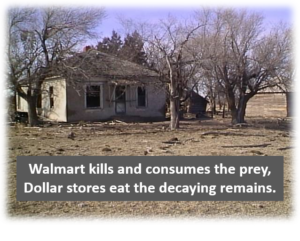
An unprecedented tag-team extraction of wealth brings with it a shining example of your “vision”: we are experiencing the economic plundering of Northwest Kansas. Your allied packer partners Tyson/IBP, Cargill, ConAgra, and Farmland rustle the cattle we produce, along with the crops and labor that go into producing our cattle, while your retail alliance partners (Wal-Mart, Kroger, and other national chain food retailers) rip the heart out of our main streets with unfair competition, including predatory pricing and daily money transfers out of our communities. They leave behind bankrupt and broken farms and ranches, less than poverty level wages, increased welfare, and people who can’t afford health insurance and medical care.

Once prosperous business owners are now working at the same Wal-Marts and Kroger owned stores that drove them out of business. They now see higher prices on the same goods they once sold to their neighbor/customers when they where in business. Today, Wal-Mart is the only grocery store in Goodland, Kansas, having driven the two independent grocers out of business. Now they expect us, like many other dying communities they pick clean, to buy their low quality, leftover, pumped, and mechanically tenderized meat and other consumer goods made with exploited labor and below cost of production raw materials – Your “Vision”!

With friends like NCBA promoting this “vision”, we don’t need enemies. How is this destruction of our food-producing, wealth-creating communities not a national security issue? How can a country, supposedly wanting to become less dependent on foreign oil, allow its domestic food suppliers to be driven out of business, their assets transferred to your allied partners’ multinational corporate bank accounts, and vital domestic production replaced by foreign imports? This massive extraction of wealth from Kansas communities has predictably left our State with a four-year cumulative deficit of $772 million, and a bunch of State legislators that can’t see the real problem for believing your propaganda.
As a cattle feeder and member of NCBA, I’ve experienced the retaliation of the packer, with no support from you. I and many other cattle feeders have been disadvantaged, discriminated against, and shut out of the marketplace while your actions continued to support non-enforcement of the Packers and Stockyards Act. Instead, you represented what was best for your allied packer and mega-retailer partners’ profits.  Largely, because of your misguided advocacy and “vision”, many of us in the cattle feeding business have been forced to exit, our operations idled or purchased at bargain prices by packer-aligned feeders who are advantaged with unfair preferences…your member feeders, who in following your advice to align with the big packer, have destroyed our cash market.

You supported biased studies – by your own and other biased Land Grant economists – and disseminated the false and misleading information forcefully. You have continued to mislead your membership, members of Congress, and the administration on ag policy and trade. You have decided to promote a centrally planned economic system that works for a few, rather than be a part of creating a competitive, democratic system that works for everyone. You are placing this nation’s food supply and economy at great risk.

I am offended by the way you use your vast media network, purchased and controlled with my checkoff dollars, to spread your propaganda and to slander myself and others. You back-bite and name-call, and ridicule those of us that are risking everything we have in this battle for competitive markets and a dependable and safe U.S. food system. We are convinced, and history proves, competition – within a just and fair marketplace – creates opportunities and prosperity… a healthy vision for our nation and the world. We are fighting powerful multinational corporations who have purchased voting rights at the NCBA, effectively hijacking a once strong cattlemen organization. Contrary to what you say, these companies have asserted control over NCBA policy and behavior.

NCBA is bankrupt in character and integrity. NCBA leadership and staff have spun, twisted, and distorted the truth for so long they have lost all credibility. You are literally killing cattlemen with your actions, inactions and accusations (check out the suicide rates with the crisis hotlines). You accuse U.S. cattlemen of overproducing. You tell them their failure is their fault, all of which you know is a lie. If you really want to begin to show integrity, you will discharge your spokesman Walt Barnhart and any others responsible for his most recent slanderous letters. Letters he crafted for unaware NCBA members to endorse for broad media distribution.
 
Despite what you think of me and other “activists” fighting for open competitive markets, economic fairness, equal opportunity, and healthy, sustainable communities, we are not the “terrorists, radical, renegade, beef-bashing, industry-destroying, ranting, garbage-spewing demigods, vegetarian, members of PETA,” you have exclaimed. Through your Director of Trade Media, Walt Barnhart, NCBA’s true personality has been exposed.
 
We are in a fight for our lives and our livelihoods against a packer/retailer cartel that continues to steal from us with impunity, while you, NCBA, provide their cover by telling law-makers and law enforcement officials, armed with existing laws that could save us, “Wait, it’s different this time.”
 
The following article is an example of how your disgraceful “free trade” policy, “no access without access”, is a loser for independent producers everywhere around the globe, and a profit windfall for your allied partners and their associates who are leveraging producer against producer and country against country: Cargill, Tyson/IBP, ConAgra, ADM, etc.
 
If you want to understand the reasons NCBA is failing and the checkoff is under attack, I invite you subscribe to the email list at www.nobull.net. You may also want to consider joining R-CALF USA  www.rcalf.com .
 
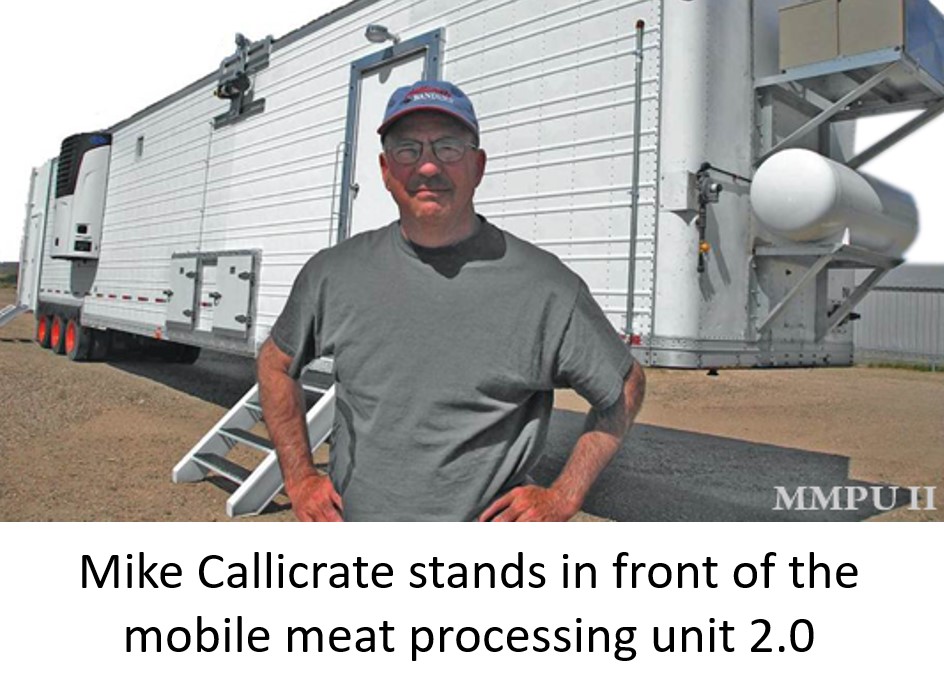
Mike Callicrate
Posted in Cattlemen's Legal Fund | Leave a comment

Wal-Mart – Tyson/IBP represent economic destruction

Wal-Mart – Tyson/IBP represent economic destruction

Wal-Mart represents a real and present danger to the economy and a serious threat to this nation’s safe and dependable food supply.  Tyson/IBP, through their abusive market power, steal the livestock that are processed into meat to be sold to Wal-Mart, now the nation’s largest food retailer. Wal-Mart, then builds a super center in the same community to sell the meat (marked up with obscene profits) back to farmers, ranchers, and consumers under an exclusive marketing arrangement with Tyson/IBP. The economic multiplier effect (often referenced by economic development experts), of a dollar produced and circulated through a community, becomes negative when the raw commodity is taken below cost of production and the finished goods are sold back to the community by a non-resident company that only leaves minimum, below living wages behind.

Last year in San Antonio, TX, in a discussion with John Tyson, CEO, Tyson Foods, I explained the class action lawsuit, now awaiting a trial date, against IBP. I explained to him that the lawsuit, if successful, could cost his company more than IBP’s total market capitalization. He very indignantly responded, “You should be suing Wal-Mart [instead of IBP], they are the problem. They tell us what they will pay and we have no choice but to pay you less.”

This illegal monopoly/cartel control of our food system is sucking the life blood out of farmers, ranchers, and main street businessmen, leaving financial ruin in our rural communities. It destroys the ability of agriculture to fuel our economy with a yearly infusion of new wealth. It undermines a safe and sustainable domestic food supply for our country.

Meanwhile, this administration stands in support of their friends at Wal-mart, Tyson/IBP, Cargill, ConAgra, ADM, etc….Companies, without loyalty to any country, that rather than pay the higher mandated costs of producing commodities in the U.S., prefer to import at the expense of foreign producers (whose markets they also control). This administration is failing in it’s duty to agriculture, consumers, and main street America by refusing to enforce existing laws designed to prevent these extreme injustices.

When we lose our markets, we lose our freedom. When we lose our food supply…

Mike Callicrate
P.O. Box 748
St. Francis, KS 67756
785-332-3344
mike@nobull.net
www.nobull.net


08/13 01:01

Wal-Mart CEO Relies on Groceries to Shield Against Slowdown
By Rachel Katz Bentonville, Arkansas, Aug. 13 (Bloomberg)

Wal-Mart Stores Inc. Chief Executive H. Lee Scott has opened about three warehouse- size stores each week since May. Some investors, concerned consumers are reducing spending, say he should keep up the pace.

These so-called supercenters, which include supermarkets, are part of Scott’s strategy of encouraging consumers to do their grocery shopping at the world’s largest retailer in the hope they’ll pick up other products as well. He plans to open almost four times as many supercenters this year as regular Wal-Mart stores, which are about half the size.

Using groceries to attract customers more often is key for Scott to meet his goal of increasing earnings at the same rate as sales in a faltering economy, some investors said.

“Even when the economy’s bad, you’re going to buy toothpaste,” said Maureen Depp, who helps manage $48.8 billion in assets at State Street Research & Management Co., which owns about 4.33 million Wal-Mart shares. Wal-Mart is “in the best position possible, because of the high proportion of basic goods.”

The Bentonville, Arkansas-based discounter said second- quarter net income will at least meet its forecast of 44 cents to 45 cents a share even after July sales missed expectations. Analysts expect Wal-Mart to report profit of 45 cents today, according to Thomson First Call.

Low Prices
People will shop at Wal-Mart in a slowing economy because of low prices, investors said. A prolonged economic stumble may hurt because shoppers probably will skip more-profitable items such as televisions, they said.

“If there’s a broad consumer slowdown, Wal-Mart’s going to be affected,” said Erik Becker, an analyst with Waddell & Reed, which owned about 1 million Wal-Mart shares among $26 billion in assets as of March.

Wal-Mart shares have fallen 16 percent this year, while the Standard & Poor’s 500 Index has dropped 21 percent. No. 2 U.S. discounter Target Corp. has shed 22 percent.
Shares of Wal-Mart fell 79 cents to $48.41 yesterday. They have declined 25 percent since Scott took over in January 2000.

Consumer spending rose at a 1.9 percent annual rate in the quarter, the slowest pace since the third quarter of 2001, the U.S. Commerce Department said. Consumer confidence fell in July by the most in nine months, according to economic consulting firm Conference Board.
Wal-Mart’s sales at stores open at least a year in July rose 4.5 percent, less than the company’s predicted 5 percent to 7 percent. The increase was triple the industry’s rise, which was 1.5 percent when Wal-Mart is excluded, according to Bank of Tokyo- Mitsubishi.

Bond Sale
Bond investors have bet Wal-Mart can maintain profit levels in an economic slowdown.
Wal-Mart last month sold $1 billion of five-year debt at an annual interest payment, or coupon, of 4.38 percent. At the time, the interest payment was lower than that on all 384 corporate debt securities of similar maturity in Lehman Brothers Holdings Inc.’s U.S. Credit Index.

“At this point, you couldn’t get a more secure holding” than Wal-Mart, said Joanne Fisher, a fixed income analyst at Pioneer Investment Management, which owns $2 million in Wal-Mart bonds among $4.5 billion in debt holdings. Pioneer didn’t buy any of the July offering.

Scott declined to be interviewed, said spokesman Tom Williams. The 53-year-old executive was paid $3.14 million in salary, bonus and other compensation last year, along with $5 million in restricted stock.

The company missed Scott’s goal of boosting earnings at the same rate as sales in 2001, when profit rose 6 percent and sales gained 14 percent. In the first quarter, profit jumped 20 percent while sales climbed 14 percent.

Grocery Bills
Wal-Mart, with sales of $218 billion last year, had 3,313 stores in the U.S. at the end of July, including 1,156 supercenters and 512 Sam’s Club warehouse stores. The company also has more than 1,200 stores outside the country.

Scott also is testing traditional grocery stores called Neighborhood Markets. Wal-Mart’s low prices enable people to cut their grocery bills by as much as 20 percent, analysts said.

“They’re going to buy less, but what they do buy, they’ll buy at Wal-Mart,” said David Abella, an analyst with Rochdale Investment Management, whose $1 billion in assets included 120,000 Wal-Mart shares.

Wal-Mart began using groceries to help insulate it from economic slowdowns in the early 1980s. Scott plans to open as many as 185 supercenters this year, an increase from 178 in 2001.
Rival Target, which doesn’t offer as many groceries, is more susceptible to a slowdown because it sells a larger portion of discretionary fashion items, analysts said. Same-store sales at Target’s discount stores rose 2.2 percent in July. Kmart Corp. filed for bankruptcy in January after trying to match Wal-Mart’s low prices.

Non-Essential Furniture
Wal-Mart’s reliance on groceries, which are typically low- margin, may backfire in an extended slowdown, investors said. Wal- Mart needs to sell non-essential items such as patio furniture to meet Scott’s earnings goal, they said.

“If consumers weaken dramatically, some of the bigger ticket items at Wal-Mart would suffer first,” said Keith Goddard, director of research at Capital Advisors Inc., whose $900 million in assets include about 1.1 million Wal-Mart shares.

Posted in Cattlemen's Legal Fund | Leave a comment

NCBA & Meat Packer Economists Promote The Big Lie: A government study isn’t needed to prove big packers and retailers are fleecing cattlemen and consumers

NCBA & Meat Packer Economists Promote The Big Lie

A government study isn’t needed to prove big packers and retailers are fleecing cattlemen and consumers

By Mike Callicrate
August 20, 2002

The August issue of Beef Magazine ran a story entitled Reality Gap, in their periodic Fact or Fiction series, examining industry misinformation. In a total affront to the truth, the piece written by contributing editor, Wes Ishmael, downplays the obscene profits in the packing and retail segments of the beef industry and attempts to confuse the issue.

National Cattlemen’s Beef Association (NCBA) economist Chuck Lambert presents a very misleading economic analysis using a 1000 pound finished animal, compared to last week’s actual average live animal weight of 1255 pounds. It costs the same to box a 1255-pound animal as it does one that weighs 1000 pounds, plus the offal income is at least $15 per head more on the heavier animal. Packers, in driving heavier more profitable finished weights, haven’t processed cattle averaging 1000 pounds for at least 30 years. According to USDA, the average live finished animal weighed 1049 pounds in 1970, forty-nine pounds heavier than his example.

Posted in Cattlemen's Legal Fund | Leave a comment

Crooked Cops at USDA and Packers and Stockyards

August 7, 2002

Crooked Cops at USDA and Packers and Stockyards

Bill Lehman, USDA meat inspector from Sweetgrass, Montana called attention to the lack of meat inspection on the Canadian border. He was ridiculed, discredited, and told to move to Oklahoma to inspect chickens. USDA is again moving people around to prevent people from doing their jobs and block enforcement. John Barthel from the Packers and Stockyards regional poultry office in Atlanta, Georgia has been appointed as regional beef supervisor in the Denver, Colorado beef office. He is packing his bags today in Atlanta for his move to Denver as his superiors lay on the beach in Hawaii, no doubt looking for anticompetitive behavior.

Why is a chicken man, who doesn’t have experience in the cattle and beef industries, being placed over experienced beef people, who are no doubt demoralized and frustrated with the inaction of their own agency in addressing anticompetitive practices of the big meat packers? P&S has either failed to act on the complaint, failed to properly prosecute, or sold out every single case that could have made a difference for cattlemen. While cattlemen are being mugged by price fixing meat packers, the government provides cover.

Could it be that big-packer-promoting USDA Secretary Ann Veneman and contract hog farmer and P&S administrator, Donna Reifschneider are in the pockets of the big packers and are determined to force cattlemen into the same serfdom as hog and chicken farmers?
Taxpayers, cattlemen, and our rural communities that are turning into ghettos deserve an investigation of USDA and P&S now.

Mike Callicrate

Posted in Cattlemen's Legal Fund | 1 Comment

The E. Coli Wars

The E. Coli Wars 
 
Guest Editorial
By KATHLEEN S. KELLEY
August 3, 2002 
 
“I said ten years ago something would finally be done when we had dead bodies.  Well we’ve had the dead bodies and still, nothing has been done.” These words came from Bill Lehman, a USDA meat inspector in Sweet Grass, Montana.  I interviewed him for a series of articles I was writing back in 1996.

Some may remember Lehman as a courageous whistle blower who risked his career to reveal, over the objections of his superiors at USDA, that deadly e-coli tainted meat used by the Jack In the Box hamburger chain had indeed been imported.  Several children died.  Lehman testified twice at congressional hearings in 1991, again in 1993 and blew the whistle on the lack of inspection at the Canadian border in 1996. He thought the whistle-blower act would protect him.

It didn’t.

Mark Manis, the then head of USDA Meat Import Inspection Division called Lehman “a loose cannon” and said he was a rogue who “needed to be under close supervision.”  By December of 1996 Lehman was ordered to report to a new assignment in Oklahoma inspecting chickens.  He told me, “I don’t know anything about chickens.”  He quit USDA.  He didn’t want anybody’s illness or death on his hands because he didn’t know what he was doing.

“God’s watching,” he explained.

Lehman died a few weeks later in 1997 of a massive heart attack.

I was inspecting tomatoes in my garden a couple weeks ago when columnist Diane Carman from the Denver Post called and asked, “what do you think of the 19 million pounds of e-coli tainted hamburger recalled by USDA from ConAgra?”

So I told her.  Some of it was harsh.  But mostly, I criticized an increasingly concentrated industry where the scale of slaughter is so large the contamination from one carcass can be mixed with 24,000 carcasses and spread from coast to coast in a matter of days.  Even more problematic, it can occur in all of agriculture where numerous food-borne illness can be spread instantaneously through our high speed mass-processing, mass-distribution system.

What I didn’t say, but should have is that I am furious with some of our key leaders in our agricultural industry who pretend every problem facing us can be solved by “turning up the heat.”  But not against the real problem.  They just increase the heat against their critics.

From the National Cattlemens Beef Association, there are sizzling e-mails calling those of us who raise these issues an assortment of derogatory names like rogue, PETA lovers, and anti-beef demigods.  There is a response letter-to-the-editor drafted in their public relations office for the signature of “a grass-roots cattle producer” so to an unwary public, it looks like the meat packers are supported by the cattlemen themselves even in their massive damage to the beef economy.  The drafters as they circulated the letter wrote, “Kathleen ought to duck.  It’s going to hurt…” referring to the planned mud-slinging campaign against those of us who dared express our concerns about the unnecessary harm this does to everyone.

Bring it on.

As cattle producers who love this industry, care for our communities and our friends, it is imperative we not let another year pass with more tragic e-coli victims.  We must not be hampered in our exercise of free speech by our detractors.  It’s their behavior that is unconscionable.  Turing up the heat to mask the problem is no solution.

Our detractors, primarily the NCBA, instead of misleading consumers about conditions in the beef industry, should join us in efforts to see that existing mandates for clean carcass standards are effectively enforced.  Instead of blindly spewing conspiracy propaganda in an effort to discredit us, they should help us fight for truly competitive markets through strong enforcement of antitrust laws so consumers have choices.  Finally, in a gesture to consumers that the truth matters, they should quit opposing strong country of origin labeling laws and regulations on meat, and support rules that label beef with substantive, accurate information instead of wasting time labeling their critics.

For all of us who enjoy beef and the lifestyle it celebrates, we must reinvent government meat inspection, shift it from USDA and put it in an agency where those it regulates, can’t control it.  In addition we must value and recreate competitive, diverse markets.  In today’s merged markets, consumers and producers are out of choices and packers can do what they please with impunity.  They just proved it.

I just wish we had Bill Lehman watching.
 
 
Kathleen Kelley is a Colorado rancher and was Vice Chair of the National Commission on Small Farms.  She was a Harvard Fellow in 1986 and taught a study group on the American Farm Crisis.
 
Kathleen S. Kelley
Meeker, Colorado
970-878-4666

Posted in Cattlemen's Legal Fund | Leave a comment