WRITTEN TESTIMONY OF THE ORGANIZATION FOR COMPETITIVE MARKETS
presented to the UNITED STATES SENATE COMMITTEE ON AGRICULTURE, NUTRITION AND FORESTRY
July 16, 2002
Hearing on Proposed Ban on Packer Ownership of Livestock and
USDA’s Enforcement of the Packers & Stockyards Act
Thank you Chairman Harkin and members of the Senate Committee on Agriculture, Nutrition and Forestry for allowing me to speak here today. My name is Michael Stumo and I am general counsel for the Organization for Competitive Markets. OCM is a multidisciplinary nonprofit organization that focus exclusively on antitrust and competition problems and solutions in agriculture. Our members consist of farmers, ranchers, academics, policy makers and agricultural businessmen.
The U.S. food industry grosses approximately $900 billion in annual sales. It is the biggest industry in the country and in the world. That money is distributed through the agricultural market infrastructure. Our family farms and ranches, as well as our rural communities, were built on that money. A perfectly competitive market would distribute that money properly. A noncompetitive market does not allow that money to flow to rural communities. Rather, dominant firms utilize their position to obstruct that monetary flow and enrich themselves far beyond the level that could otherwise be achieved without near-monopoly power. The result is an increasing rate of farm failure, increased consumer food prices, and harm to the public interest.
I. The Nature of Agricultural Markets and the Need for Market Facilitating Rules
The role of government in the marketplace is to create and maintain the infrastructure for the most people and companies to engage in commerce. The analogies are the internet and the U.S. interstate highway system. The internet is not commerce or communication. Rather, it is an infrastructure that facilitates cheap and effective commerce and communication. It is not proprietary. It is accessible by most everyone, and it is very easy to access.
Similarly, the U.S. interstate highway system is not commerce. It facilitates commerce. Everyone can use it. There are many on ramps and off ramps. General Electric uses the system and so does my mother. The government maintains it and applies a set of equitable rules to the infrastructure. The payback has been incredible.
It may be efficient for four companies to acquire exclusive use of 50% of the internet or 90% interstate highway system. But it is efficient only for the companies’ profitability. It is not beneficial for the country because it denies the benefits of commerce and communication to the displaced users.
The livestock marketplace must be similarly open, accessible and fair to benefit the broadest number of people. We must have rules that maintain access by all through many on-ramps and off-ramps. We must maintain inexpensive use by all under equitable terms. If a company feels it would be more efficient to exclude others from the system, that desire must be recognized as in conflict with the public welfare. We must maintain the ability for the broadest participation in commerce possible for widespread rural economic health.
Federal policy applied to the stock markets has promoted fairness, access, transparency and competition in the stock markets. The result is that 80 million people own stock, a far larger percentage of the population than of any other country, and those people can make trades easily and cheaply. Federal policy applied to the livestock markets has promoted unfairness, market closure, secrecy, and monopolistic practices.
We need to rethink the emphasis on efficiency in macro-market policy. “Efficiency” is relevant to a firm producing more for less money, but it is far less relevant to proper market operation. Stated another way, if efficiency gains occur, a competitive market will distribute those efficiency gains to society. In a non-competitive market, the efficiency gains are not distributed.
The analysis relating to market facilitation and efficiency should be as follows: First, the focus should be on creating a market system that is fair, accessible, transparent and competitive. The internal logic here is separate from efficiency. Second, if efficiency is raised as a negative factor, the following four questions must be asked before balancing the efficiency argument with the anticipated market facilitation effects: (1) Are the claimed efficiency gains/harm real? (2) Are the efficiency gains directly related to the market practice at issue? (3) Is there no other way to achieve the claimed efficiency gains? (4) Are the efficiency gains likely to be passed on to consumers or farmers, or is market power likely to obstruct passing the gains on to others. If the efficiency gains are real, related to the practice at issue, achievable in no other way, and likely to be passed on to consumers/producers, then we can quantify what efficiency gains are relevant and weigh them against the positive effect of the market facilitating rules contemplated.
A. Captive Supplies: The Problems
Captive supplies of livestock are all livestock committed to packers through packer ownership and contracts more than seven days prior to slaughter.[1] The fundamental market problems of captive supplies are threefold: (1) market closure; (2) market unfairness; and (3) enabling packers to “game the system” just as Enron and Dynegy gamed the energy trading system.
1. Market closure
Captive supplies have progressed to the point where hog farmers cannot get bids or access to markets, even in states with large packing capacity, such as Iowa, Nebraska and Minnesota. Pork packers own 20 percent to 25 percent of the hogs they slaughter. That is 77,000 packer owned hogs per day at 22%. That is over 20 million hogs per year that displace family farm produced hogs. This, at its core, dampens or excludes widespread rural commerce. If we like a diverse and decentralized production system, we are not promoting it.
But what of the remaining “open market” participants? We know that about 16% of each day’s slaughter is claimed to be open market, using USDA daily market news reports.[2] No one disagrees that farmers have difficulty accessing the market. But what is not widely known is that most farmers who seek bids on their hogs no longer get bids, even in Iowa which has more pork slaughter capacity than any other state. Rather, they get “slots” or “shackle space” at some time in the next seven to fourteen days. The packer tells the farmer what the price is after the hogs are delivered. That price is reported to USDA Market News Service. No bids. No competition. That is our dysfunctional open market price discovery system. We are losing much decentralized economic activity in the form of broad family farm market participation.
2. Market unfairness
To the extent participation is allowed in the markets, participants are treated unequally. Large corporate producers receive preferential contracts. For example, the large feedyards owned by Sparks, called Cattle Co., appear to have contracts with packers which allow significant price advantages over other producers of cattle. It is undisputed that producers are treated disparately with regard to contract offerings, bids, and access. But it is disputed whether these practices are legitimate. If we apply basic and successful market principals to our evaluation of these activities, the answer is clear that disparate treatment is contrary to proper market operation and contrary to the public interest.
If a small farmer produces high quality hogs, he/she should get access to prices and shackle space according to quality, not quantity. If a large farmer producers high quality hogs, the same result. Size is not relevant to hog quality. Further, the transaction costs arising from purchasing from many producers, rather than a few large producers, is so small as to be insignificant. The primary goal should be fairness and access to facilitate widespread and decentralized rural commerce.
A properly functioning free market provides uniform rules for all participants on price, premiums, discounts and access. The stock market does so. Warren Buffet gets no better terms than Michael Stumo when buying stock at a particular time – even if he buys 500,000 shares of GE when I buy 50 shares. Buffet may analyze information and have better strategies to time his purchases and sales, but we have equal market access at the same price on any given time and date of trading. The same should be true in the livestock markets.
The Packers & Stockyards Act should be to “live-stock” what the Securities and Exchanges Acts are for “paper-stock.” The law is written to enable this result, but USDA has failed. More on that later.
3. Manipulating or Gaming the System: The Incentive Structure
When constructing proper market rules, the proper approach is to counteract the incentives to manipulate the market or “game the system.” Looking for proof of harm after-the-fact is not beneficial and this method has failed. Further, a focus on efficiency has not proven helpful and has failed.
Enron and Dynegy “gamed the system” with regard to California energy markets. They used strategies such as Death Star, Fat Boy and Get Shorty in creating fictional transactions, creating perceived shortages, and trading advantageously in the situation they created. They got wealthy, but Californians were thrown into crisis.
When undue importance is attached to a number, undue efforts are made to manipulate that number. On Wall Street, the key number is earnings. Shady accounting strategies are used to manipulate that number. Bernard Ebbers of WorldCom is the poster child for this scenario. But tremendous energy is expended by defenders to justify those strategies as legitimate. In the livestock markets, the key number is the open market price. Similarly, shady marketing strategies are used to manipulate that number. And tremendous energy is expended by defenders to justify those strategies as legitimate.
Captive supplies, such as contracted and packer owned livestock, are the raw material for market strategies equivalent to Death Star and Fat Boy. By strategically scheduling captive hogs to stay out of the market, drive the price down, and jump into the market to buy at low prices, packers make tremendous amounts of money. Farmers lose tremendous amounts of money. Yet valiant attempts are made to convince us that captive supplies are justifiable.
The fundamental principal here is that when the market is dominated by a few firms that are repeat players in a very thin market, the motive and opportunity to manipulate that thin market is so real as to be undeniable. Bob Peterson, former CEO of IBP, spoke to the Kansas Livestock Association in 1988. The following comes from the tape of his speech:
“Our competitors are promoting contracts and seeking more. These forward contracts coupled with packer feeding could represent a significant percentage of fed cattle at certain times of the year. Do you think this has any impact on the price of the cash market? You bet! We believe a significant impact. Large volume forward contracting and its inevitable connection to the futures trading pit in Chicago will foster sever price distortions in the cash market. In the event that contracting becomes the wave of the future, and frankly I doubt that sharp feeders will allow that to happen, IBP will be forced to respond to the competitive pressures of the market place.” (emphasis added)
Even Wayne Purcell of Virginia Tech, who opposed the packer ownership ban, understands the manipulative incentives in the current system.[3] In testimony before USDA in Denver in September, 2000, he wrote that “[w]hether buyers attempt to manipulate the cash market to which the contract price is tied is somewhat immaterial because the incentive to do so is present and is undeniable.” It is this motive and opportunity, aka the “incentive structure,” that should govern legislative judgment to prevent manipulation.
Past USDA studies have shown a high correlation between increased captive supplies and lower prices. The most detailed study of this relationship was published in 1999, using subpoenaed packer information with the support of USDA. That study, in the beef industry, found that “a robust empirical relationship [between captive supplies and low prices] was found in every case.[4] For folks who are confused, this means that when captive supplies are dumped on the market, prices drop. The economic incentive is thus shown. More captive supplies make more money for packers.
USDA explains this away saying that this correlation does not give them causation. But economists cannot achieve “causation.” Rather, a major ADM-style price fixing case with testimony, hidden cameras, and the like is necessary to give causation to the extent needed by USDA. It is time for a legislative judgment to be made.
Let us quantify the economic incentive to game the system by using captive supplies to manipulate the price through an example. If packers can use captive supply to drive down the open market price by one dollar on a day, the procurement savings is $910,000 each day (assuming a daily hog slaughter of 350,000 head at 260 pounds per animal). That is $910,000 taken from farmers. On an annual basis, that is $237 million taken from farmers and transferred to packers as compared to a competitive market result. If captive supplies drive the price down by two dollars per day, we double the farmer loss and double the packer gain.
How can a dominant packer buyer game the system? The easiest way is for a packer to schedule blocks of captive supply livestock for slaughter over a period of time, pull out of the market during that time and watch the open market price fall. Then the packer can jump into the open market to buy cheaply. That cheap open market price not only saves money on the open market hogs directly, it also cheapens the tens of thousands of hogs per day that are contracted using a formula based on the open market price. If any packer buyer does not known how to do this, it is likely that any such packer buyer has moved on in his career.
Further, a packer contracts for the best hogs and, as a result, the open market becomes residual. By “residual,” it is meant that the poorer, less desirable hogs are sold on the open market. The open market price reported by USDA Market News Service is, thus, the value of the poorest quality animals. The perverse result is that the poor quality hog price becomes the base price for the hogs procured under formula-price contracts (“formula price” contracts derive the sale price based on a formula which uses the open market price as the starting point).
Additionally, the futures market relies most heavily on the open market in determining price for the future. If the open market is broken, the damage is transferred to the futures markets. In other words, the captive supplies derivatively drive down the futures market because of futures traders’ heavy reliance on open market price data.
Lastly, because producers selling in the open market have no realistic bid choices, they engage in “panic selling” rather than negotiation. Certainly it is difficult to negotiate when there is only one willing buyer in the region and that buyer does not bid but merely doles out shackle space with the promise of an arbitrary “price” upon delivery. The cumulative result of panic selling is not a price arising from a competitive market. From what is that post-delivery price derived from, a market? Packer gratuity? Certainly not competitive bidding.
B. Captive Supplies: The Solutions
The only solution to captive supplies is structural, not a conduct remedy. By a “structural remedy,” I mean limiting or eliminating the partial vertical integration known as captive supplies. A “conduct remedy” means that we do not limit captive supplies but merely pass or enforce a law to prevent unlawful conduct that captive supplies could enable. Structural remedies are preferred because they do not require significant policing due to the fact that the ability to manipulate markets is taken away from dominant firms. Conduct remedies are not preferred because they require constant policing by regulators in a very intrusive way to be effective. Such constant policing has historically not been undertaken or effective.
1. Packer Ownership Prohibition
The packer ownership prohibition is the first step in making the markets work properly and limiting the ability of packers to game the system. This legislation would take a portion of the strategic scheduling ability away from the dominant packers and make the market more responsive to true supply and demand. It would also increase access to markets by more producers.
While some studies predicted crisis from banning packer ownership, those studies can be dismissed by one simple analysis – i.e. the historical record. The studies were not based upon the historical record, but upon wildly speculative economic projections. We know that the drastic financial losses in the industry will not occur because packer ownership prohibitions have been in effect for several years in Iowa and Nebraska. The predicted losses did not occur. Those states had, and continue to have, the largest packing capacity for hogs and cattle, respectively, in the nation. Those states have as many or more producers of hogs and cattle as any state. The strength or decline in production agriculture has not been affected in a manner more drastic than other states. Yet, the percentage of family farmers producing livestock is as high or higher than other states.[5]
2. Enzi legislation on livestock contracts
Senator Enzi has proposed a bill (S. 2021) that would require all contracts to have a fixed base price at the time of the agreement and would also require open public bidding of these contracts. This bill would transform the contract market from a secret, preferential, market harming scenario into an open market in and of itself. A contract market would still allow quality specifications and risk management. But it would severely limit the ability of packers to use contracted supplies to manipulate price.
Importantly, the Enzi bill has basic requirements for the contracts similar to the futures markets. There is a relatively small volume requirement, 40 head per contract for cattle and 30 head for hogs, that allow small producers to bid on contracts while large producers bid on more contracts. However, that legislation could be improved by adding a 14 day delivery window for each contract to limit strategic scheduling by the packer to affect the spot market price.
II. The Regulatory and Enforcement Regime
The Packers & Stockyards Act (the Act) gives Secretary of Agriculture authority over the meat packing industry.[6] Unfortunately, past secretaries (or their designates) have stood before Congress stating that their authority is unclear or insufficient to encompass antitrust issues under the Packers & Stockyards Act. Those statements have been false. The Act provides the Secretary more authority over the packing industry than any other statute provides any other agency over any other industry. The Conference Report issued at the time of the Act stated that “Congress intends to exercise in the bill, the fullest control of the packers and stockyards which the Constitution permits.”[7]
The Act prohibits unfairness, deception, price manipulation, and the creation of a monopoly, among other things.[8] The role of the secretary is, and has been, to undertake two categories of activities: (1) propound regulations refining the definitions of the prohibitions in the Act; and (2) enforce the Act and the regulations under the Act. Past secretaries have failed to perform these obligations. The current secretary shows no inclination to alter that trend.
A. Rulemaking
The most inexpensive way to facilitate proper market operation, to minimize industry efforts to “game the system,” and to increase fairness, access, transparency and competition is to propound regulations under the Act.
It is helpful to look to the FTC Act of 1914 as an analogy because of its similarities to the P&S Act and because of its more effective caselaw and regulatory development. The FTC Act prohibits “unfair and deceptive practices” as well as “unfair competition.” The FTC has issued regulations and guidelines defining what these terms mean in the economy. The “unfair and deceptive practices” have given rise to the FTC’s Consumer Protection Bureau while the “unfair competition” clause gave rise to the Competition Bureau. A similar dichotomy in the P&S Act in which the unfairness and deception clauses relate to “Producer Protection” while the price manipulation and monopoly creation prohibitions relate to competition or antitrust.
Unlike the FTC, the Secretary has failed to issue regulations or guidelines defining the key terms of the Act, including:
a. unfair practices under 7 U.S.C. 192(a);
b. deceptive practices under 7 U.S.C. 192(a);
c. unjustly discriminatory practices under 7 U.S.C. 192(a);
d. undue or unreasonable preference or advantage under 7 U.S.C. 192(b);
e. apportionment of supply that restrains commerce or creates a monopoly under 7 U.S.C. 192(c);
f. price manipulation, control of prices or creation of a monopoly under 7 U.S.C. 192(d);
g. conspiracies under 7 U.S.C. 192(f) and (g); and
h. apportionment of territory, apportionment of purchases or sales, or manipulation or control of prices under conspiracy under 7 U.S.C. 192(f).
Further, the Secretary has failed to issue regulations or guidelines for other duties under the Act, including:
a. defining unusual or suspicious marketing activity or pricing;
b. when and how to refer violations of the Packers & Stockyards Act to the Attorney General as set forth in 7 U.S.C. §404;
This failure to refine and define the Act through regulations is at the heart of the USDA’s failure to minimize unfair and deceptive practices and maximize competition. Without internal policy guidance, the USDA is limited to an ineffective “I know it when I see it approach” which is gives no direction to employees investigating market activity.
Two reasons for these failures are USDA responsiveness to industry pressure and a pre-occupation with efficiency as a primary goal. USDA fails to recognize that: (a) efficiency is irrelevant to unfair or deceptive practices; (b) efficiency is irrelevant if lack of competition fails to pass efficiency gains on to producers or consumers; and (c) efficiency is a micro-concern within a firm and increasingly conflicts with competition principals.
B. Enforcement
Even if rules are clear, intelligent and effective, they are without value unless enforcement is effective. Enforcement of the Act can come from three sources: (1) USDA-GIPSA in an administrative proceeding; (2) the Department of Justice in federal district court; and (3) private litigation. Public enforcement by USDA has failed. Public enforcement by the Department of Justice has not existed. Private enforcement has been hampered by the lack of an attorneys fees provision and a treble damages provision, both of which exist under the Sherman and Clayton Acts, to help farmers pursue remedies when they have been harmed.
What is the role of each means of enforcement? USDA and DOJ enforcement – in the best case case scenario of political will, sufficient expertise, and sufficient funding – is limited to high profile cases that set precedent. Government enforcement cannot hope to be the primary means of stopping all unlawful practices. Rather, private litigation by farmers and ranchers who are actually harmed is the best way to guarantee effective and widespread enforcement of the run-of-the-mill violations.
1. USDA enforcement
USDA has tried to use enforcement proceedings before administrative law judges as a substitute for rulemaking. Using their I-know-it-when-I-see-it approach, and without the guidance of regulations, USDA has sued major meatpackers for preferential pricing (In re Beef Marketing Group) and unlawful market retaliation (In re Farmland National Beef Co.), for example. While those cases were mid-to-late-1990’s exceptions to the historic “lack of any enforcement rule” at USDA, they failed to succeed primarily due to the lack of regulations defining unlawful practices under the Act. The administrative law judges hearing these cases had no regulations to guide their decision making and were left to ad hoc decision making. Because of those enforcement failures in the recent past, USDA is even more reluctant to litigate and has not begun to propound necessary regulations.
Even if USDA was willing to, and able to (funding and expertise-wise), increase enforcement activities, only the most significant cases would be undertaken – those with precedent setting potential. This is the history of enforcement in other antitrust contexts at DOJ and FTC. While this approach would be laudable if undertaken, there is no prospect that USDA can address all unlawful activities in the countryside.
2. DOJ enforcement
There is a process by which DOJ may be called upon by the Secretary to bring an enforcement action under the Act in federal district court.[9] However, to OCM’s knowledge, this process has never been utilized. Again, the best case scenario is that this mechanism of enforcement would be limited to precedent setting cases, rather than run-of-the-mill violations.
3. Private litigation
The Act allows producers to engage in private litigation in pursuit of damages caused by packer harm.[10] Private litigation historically holds the most promise for comprehensive enforcement. This is because the incentive is extremely strong for those actually harmed by unlawful activities to pursue a remedy. However, the number of private cases has been very small since private suits were allowed in 1976.
The reason that farmers and ranchers have been unable to prosecute private suits is that there are no attorneys fees provisions or treble damages provisions under the Act. The Sherman and Clayton Acts have such provisions and, thus, private enforcement has complimented public enforcement. Without these provisions, the cases are too expensive to undertake due to their complex nature and the vigorous defense of packers. The solution is to amend the Act to allow farmers who win a suit to receive attorneys fees and treble damages. This is not a sop to trial attorneys, it is a provision needed for farmers to gain effective legal representation.
C. Solutions within USDA
Rulemaking and enforcement of the Act must be given a higher priority at USDA. This high priority must be accompanied by more professionalism, focus and funding directed at competition and fairness issues. Currently, GIPSA is a small, underfunded corner of the vast USDA bureaucracy. Field investigator recommendations for enforcement activity must go through several layers of bureaucratic scrutiny before final approval – and final approval for significant action usually does not occur.
Again, an analogy to the FTC is helpful. In the late 1960’s, the Federal Trade Commission was justly criticized for being ineffective and unprofessional. A Nader Report and an American Bar Association report criticized the FTC for: poor leadership, lack of direction, aimless enforcement, and squandered resources. The fundamental question was whether the agency should be abolished or reformed.[11] The FTC chose to implement the solutions recommended in the ABA report.
In a June 12, 2001 speech before the American Antitrust Institute, current FTC chairman Timothy J. Muris recalled those thirty-years-ago changes:
For consumer protection, the Report prescribed vigorous law enforcement and a national role in developing consumer protection policy. More specifically, it recommended that the agency:
Focus enforcement on serious consumer problems, especially fraud.
Mount a more effective campaign against deceptive advertising.
Strengthen its remedies and reduce delays.
Provide industry guidance and incentives for compliance and self-regulation.
Undertake studies, issue reports, and make legislative recommendations directed at pressing consumer issues.
Work with state and local consumer protection agencies.
Make consumer education part of the agency’s mission.
For competition, the Report prescribed that the Commission use its unique history and institutional advantages – those not available to the Department of Justice Antitrust Division – to advance competition policy and enforcement. More specifically, the Report recommended that the agency:
Use the “full panoply” of its institutional tools to make competition policy – doing research, publishing studies, bringing cases, and making use of the intersection of competition policy and consumer protection authority.
Formulate national competition policy by using the administrative process to adjudicate cases.
Make policy involving “unsettled” areas of the law.[12]
Thus, the FTC became far more effective and respected.
GIPSA is in a similar position to the old, ineffective FTC. It currently suffers from poor leadership, lack of direction, aimless enforcement, and squandered resources. However, it can use the tools at its disposal to provide focus and effectiveness, including: rulemaking, studies, legislative recommendations and enforcement. It can take advantage of the confluence of its producer protection authority and competition authority to set national policy towards a more fair, accessible, transparent and competitive market infrastructure.
Congress can facilitate this process by creating an undersecretary level position at USDA with the following (or similar) title: Office of Special Counsel for Competition and Producer Protection. The position should be filled by an attorney experienced in such matters, appointed by the president with the advice and consent of the Senate. That office, under this scenario, would house all USDA authority and personnel relating to agricultural competition and fairness such as the Packers & Stockyards Act, the Agricultural Fair Practices Act, and the Mandatory Price Reporting Act. The office would have the authority to propound regulations, initiate enforcement proceedings, interact with the Department of Justice, conduct studies and recommend legislation.
The goal should be an FTC-style remake of USDA-GIPSA. USDA is the largest agency after the Department of Defense. It engages in a wide variety of activities other than antitrust-style enforcement. If Congress agrees with farmers and ranchers that competition and fairness policy is a priority, then the USDA structure should reflect that priority and be empowered with the resources and leadership. The creation of an Office of Special Counsel for Competition and Producer Protection would greatly assist in accomplishing that goal.
III. Conclusion
There is no credible argument to be made that the livestock markets are working properly. There is no credible argument to be made that the regulatory and enforcement regime is equal to the task before it. Congress should dispense with the past fascination with efficiency as a dominant goal.
Rather, Congress should focus on creating and maintaining a livestock market infrastructure in which all producers, of whatever size, can participate on equal terms without displacement by captive supplies. Congress should focus on market facilitating rules based upon fairness, access, transparency and competition. The access and widespread participation on the internet, the U.S. highway system and the stock markets should be the governing metaphors or analogies.
The proper analysis when balancing market facilitating rules with claims of losses in efficiency is as follows: First, the focus should be on creating a market system that is fair, accessible, transparent and competitive. The internal logic here is separate from efficiency. Second, if efficiency is raised as a negative factor, the following four questions must be asked before balancing the efficiency argument with the anticipated market facilitation effects: (1) Are the claimed efficiency gains/harm real? (2) Are the efficiency gains directly related to the market practice at issue? (3) Is there no other way to achieve the claimed efficiency gains? (4) Are the efficiency gains likely to be passed on to consumers or farmers, or is market power likely to obstruct passing the gains on to others. If the efficiency gains are real, related to the practice at issue, achievable in no other way, and likely to be passed on to consumers/producers, then we can quantify what efficiency gains are relevant and weigh them against the positive effect of the market facilitating rules contemplated.
Legislation should take away the ability for dominant firms to game the system. Captive supplies are the primary mechanism for such manipulation. Rather than requiring proof of past harm, the regulatory approach should look to the incentives in the system. Stated another way, Congress should focus on preventing future harm that is likely to occur because of the incentive and ability to manipulate price or engage in other strategic conduct that would be profitable to a firm but contrary to the public interest.
Thus, the packer ownership ban should be passed. The Enzi captive supply bill should be passed. Any efficiency claims attached to captive supplies are both unproven and eclipsed by the market disruption caused by the practice.
An Office of Special Counsel for Competition and Producer Protection should be created at the undersecretary level within USDA. That office should take over all competition, producer protection, and price reporting functions. That office should also be infused with leadership that can remedy the problems of poor leadership, lack of direction, aimless enforcement, and squandered resources. In doing so, that office can make use of the tools at its disposal including: rulemaking, studies, legislative recommendations and enforcement.
Michael C. Stumo
On behalf of the Organization for Competitive Markets
Tel: 860.379.6199
Email: stumo.and.milleron@snet.net
Internet: www.competitivemarkets.com
————————————————————————
[1] The industry, specifically most cattlemen’s associations that have addressed the issue, uses the seven day rule. However, USDA-GIPSA uses a 14 day prior-to-slaughter rule. See, USDA GIPSA publication, “Captive Supply of Cattle and GIPSA’s Reporting of Captive Supply,” released January 18, 2002 (on the web at www.usda.gov/gipsa/pubs/captive_supply/captive.htm).
[2] This 16% contemporary figure is part of a declining trend in open market hog trading. If the current trend continues, the open market will disappear in 2004.
[3] Purcell, Wayne D., Contracts And Captive Supplies In Livestock: Why We Are Here, Implications, And Policy Issues, Testimony at the Denver Captive Supply Forum, dated September 21, 2000.
[4] John R. Schroeter and Azzedine Azzam, Econometric Analysis of Fed Cattle Procurement in the Texas Panhandle 46 (November 1999).
[5] See, Welch, et al., “On the effectiveness of state anti-corporate farming laws in the United States,” Food Policy 26 (2001) 543-548.
[6] 7 U.S.C. §§181 et seq.
[7] Conference Report, H.R. Rep. No. 324, 67 Cong. 1st Sess., at 3 and 5-6 (1921).
[8] 7 U.S.C. §192.
[9] See, 7 U.S.C. §224.
[10] See, 7 U.S.C. §209.
[11] See, Muris, Timothy J., “Robert Pitofsky: Public Servant and Scholar,” Speech to the American Antitrust Institute, June 12, 2001. (available at www.ftc.gov/speeches/muris/muris010612.htm).
[12] Id.

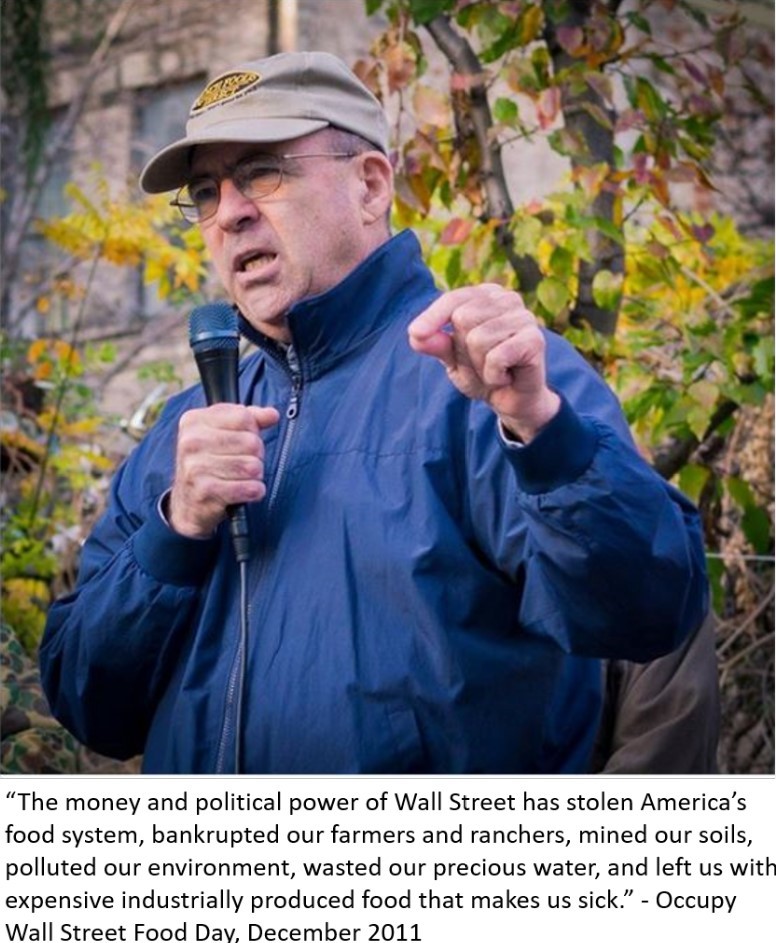
 “The money and political power of Wall Street has stolen America’s food system, bankrupted our farmers and ranchers, mined our soils, polluted our environment, wasted our precious water, and left us with expensive industrially produced food that makes us sick.” – Occupy Wall Street Food Day, December 2011
 Industrial Agriculture and Urban Sprawl – A model of growth that’s made to fail.


 Photo: Sean Cayton - 2003People producing good food from happy animals, while improving the environment, shouldn’t have to fear the government.