“… turning a criminal actor loose on American investors.” – Mike Callicrate
JBS, the Brazilian meat-packing giant known for bribery and corruption scandals, just went public. The company was previously denied access to U.S. markets — until they donated millions to Trump’s inaugural fund. Now, small farms across the country are sounding the alarms.
More Perfect Union is an Emmy-winning, nonprofit newsroom whose mission is to build power for working people. Here’s what that means: We report on the real struggles and challenges of the working class from a working-class perspective. We attempt to connect those problems to potential solutions. We report on the abuses and wrongdoing of corporate power. And we seek to hold accountable the ultra-rich who have too much power over America’s political and economic systems.
When Callicrate Cattle Company was blacklisted by the big meat packers, we shifted to selling meat instead of livestock. The alternative market approach goes around the current concentrated and corrupt food system, giving consumers a better food option.
Over thirty years ago, Dr. William Heffernan was traveling the country warning cattle producers of the dangers awaiting them in contract poultry growing, how it enslaved growers with debt and relegated them to a life of servitude under the boot of corporate integrators. For the most part, except for organizations like R-CALF and the Organization for Competitive Markets, cattle groups like National Cattlemen’s Beef Association and Farm Bureau praised the direction of the industry under the control of a handful of transnational corporations, making beef more vertically integrated, like poultry – known as “Chickenization.”
So today, we have the lowest cow numbers in seventy-five years. McDonalds is suing the big four packers for unnecessary herd liquidation, half our ranchers are out of business, we’re making cattle weigh 1,500 pounds to make up for the lack of supply, with 37% too lame to walk soundly to slaughter. 2025 Brazilian beef imports are up 288% over 2024, and JBS, the biggest meatpacker in the world and convicted criminal, too crooked to be bankable, is going after the free investment money of the NYSE.
Walmart has built it’s Angus supply chain avoiding the big meatpackers. Is Bezos looking to do the same for his Amazon and Whole Foods?
Meanwhile, Jeff Bezos is catching hell for throwing a few dollars at the American Angus Association, seeing that his big competitor, Walmart, is making investments with Creekstone, 44 Farms, Sustainable Beef, etc., in their chicken-like vertical beef supply chain featuring the Angus breed. So can we blame Bezos?
We are honestly almost there in the complete “Chickenization” of the cattle and beef industries where all wealth is extracted, leaving the people that invest the capital and do the work of ranching, with no options but to submit, as a cost to be reduced, to the concentrated power of big meatpacking, big food service, and big retail.
Listen to Dr. Heffernan explain, with remarks directed at IBP’s Robert Peterson, during the 1996 South Dakota Governor’s Cattle Conference.
“When corporations come in, the return, the profits, the
economic base of our rural communities is cut precipitously.” Dr. William Heffernan
Dr. Heffernan warns Bob Peterson, IBP wasn’t big enough to compete with transnational conglomerates. Five years later, IBP, the largest beef and hog slaughterer in the world was purchased by the biggest chicken integrator, Tyson. The king of meats was dethroned by big chicken, and cattle producers were placed on the road to serfdom and a cost on a P&L to be reduced.
Why are big food retailers building their own supply chains? Because they intend to extract every dollar possible from agriculture.
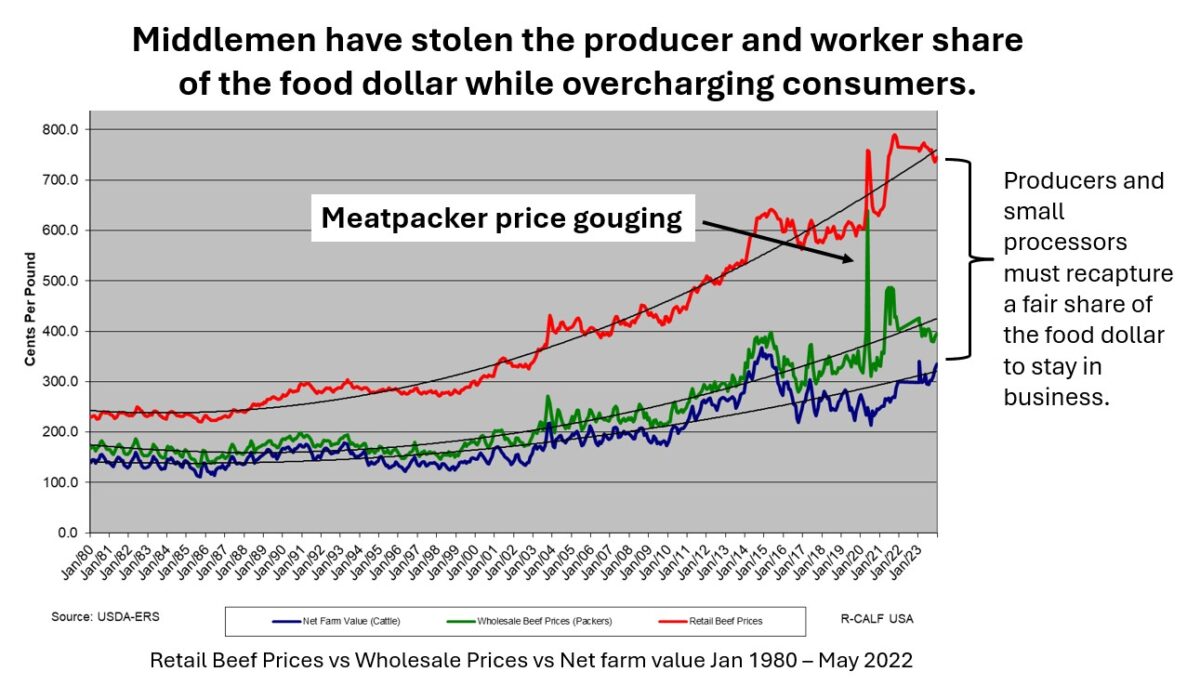
The Walmart family and Bezos will fight to keep their unfair share of the consumer dollar, forcing U.S. cattle producers out of business. They didn’t like it when Tyson and the other big meatpackers price gouged them during the pandemic.
To hear the complete list of speakers, including IBP president and CEO, Robert Peterson blaming South Dakota Cattle producers for the ills of the industry, go to the 1996 South Dakota Governor’s Cattle Conference
As the U.S. economy reels from the impacts of tariffs, and cattle and beef supplies run short, we should go back and try to understand how we got here. How a handful of corporations leveraged Canadian and U.S. producers against one another to profit and capture our food supply.
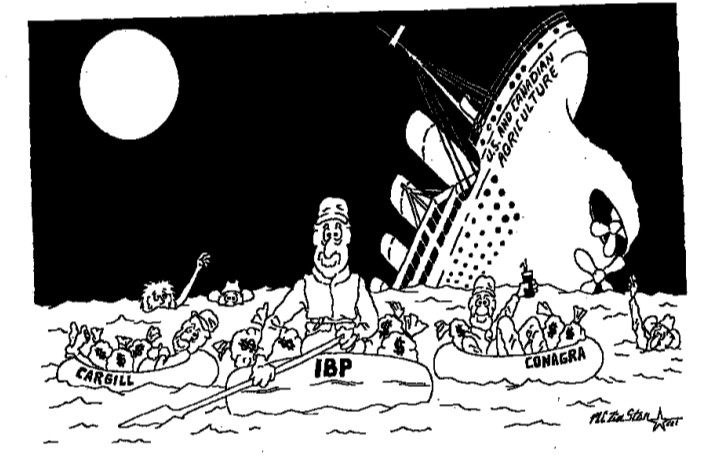
The picture above is from a 2003 presentation at the Tiffin Center in Lethbridge, Alberta, Canada. As you can see from the following presentation, there was push back to the growing corporate concentration, but only by a few, mostly ignored voices.
The two biggest cattle feeders in Canada were in the audience that winter day. Although highly subsidized, many of the best and most efficient Canadian feeders were driven out of business by the meatpacking cartel – IBP (now Tyson), ConAgra (now JBS), and Cargill, the same market predators cooperating in the demise of our U.S. cattle industry.
Montana cowboy and cartoonist, Wally Badgett, captured the reality.
“Professional management and efficiency can be instruments to impoverish communities or they can be instruments to enrich communities…The Priority of People Over Capital.” – Greg MacLeod
Subscribe to information and news updates related to farming, food and health issues, click here!
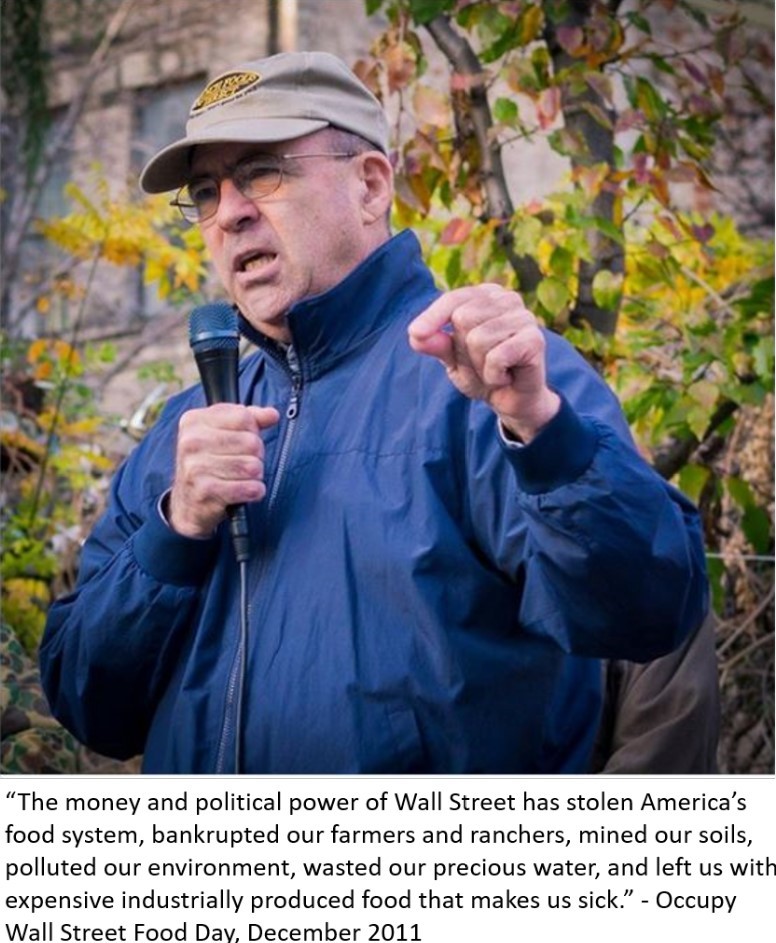
“The money and political power of Wall Street has stolen America’s food system, bankrupted our farmers and ranchers, mined our soils, polluted our environment, wasted our precious water, and left us with expensive industrially produced food that makes us sick.” – Occupy Wall Street Food Day, December 2011
Industrial Agriculture and Urban Sprawl – A model of growth that’s made to fail.
Ranching Reboot Episode 4, Mike Callicrate “It’s time for a third revolution against monopolies”
Above: Ranching Reboot – Episode 4 – Mike Callicrate, owner of Ranch Foods Direct, sat down with us to talk about all manner of things from cattle markets, to public food spaces, the Bander, his feedlot and the pathway he built to market.
He shares valuable lessons learned from fighting against the commodity production system and how he’s built his own pathway to the consumer.
We talk about small community slaughter plants and public meat spaces and what that could look like going in to the future. We discuss environmental challenges, the food police and what it means when a Dollar General comes to town.
by John Munsell | Oct 11, 2011
Opinion Editor's Note: This is the first part in a series written by John Munsell of Miles City, MT, who explains how the small meat plant his family owned for 59 years ran afoul of USDA's meat inspection program. The events he writes about began a decade ago, but remain relevant today.
They say that confession is good for the soul. I've been involved in a series of ugly events since my plant in 2002 recalled 270 pounds of ground beef contaminated with E.coli O157:H7 and now want to admit the embarrassing truth for public review.
more

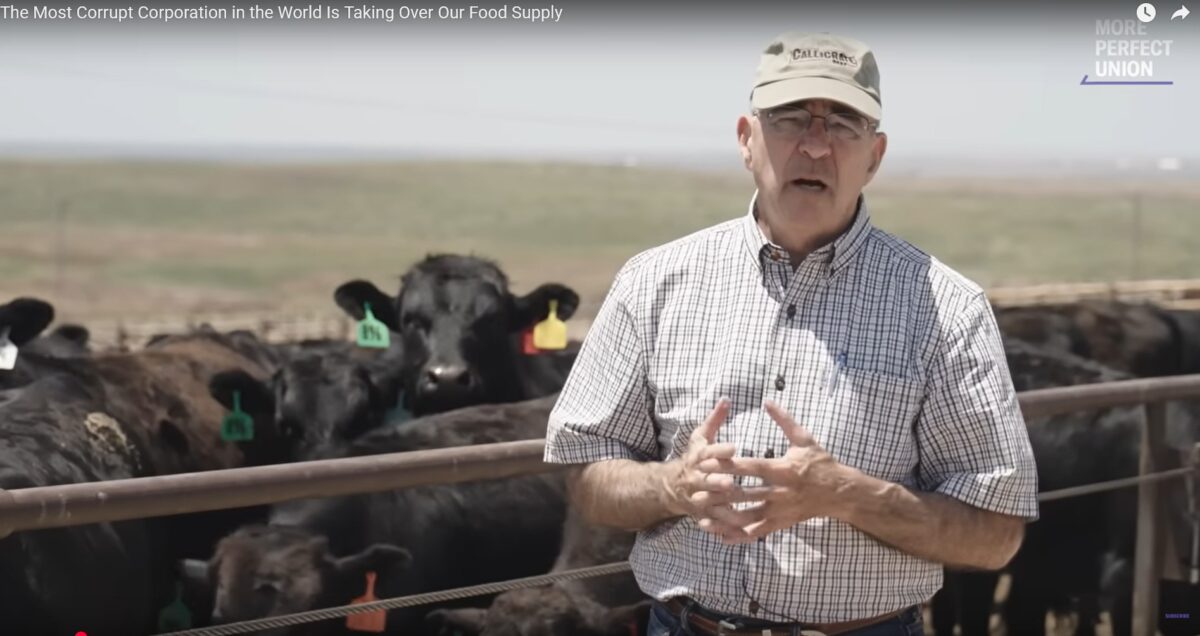
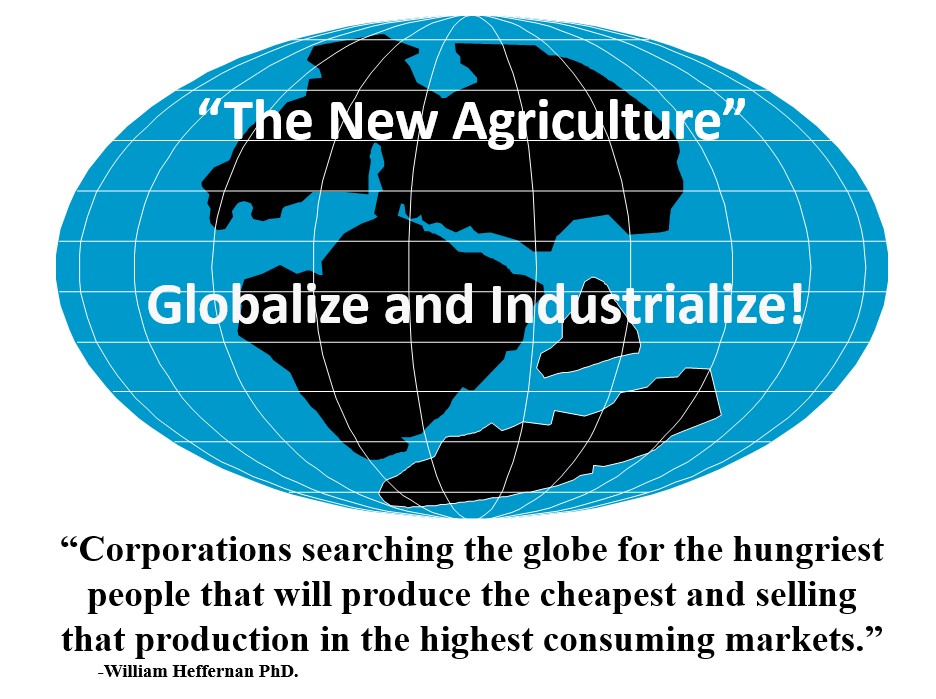 The picture above is from a 2003 presentation at the Tiffin Center in Lethbridge, Alberta, Canada. As you can see from the following presentation, there was push back to the growing corporate concentration, but only by a few, mostly ignored voices.